


Updated on October 20, 2026.
In this article
Welcome to this structured guide for learning and mastering the Bengston Healing Method. Here you will find theoretical explanations and practical exercises organized into a daily learning schedule, ranging from basic to advanced levels. The guide is divided into clear sections to facilitate easy reference and ongoing study.
1. Introduction to the Bengston Healing Method
The Bengston Method is an innovative energy healing technique developed by researcher William F. Bengston, PhD, over more than 35 years of investigation. Unlike mystical practices, it is a hands-on healing method focused on intention and visualization, independent of religious beliefs or special gifts. Bengston was originally a skeptic until he experienced a personal healing that motivated him to study alternative healing phenomena academically. Since then, he has achieved impressive results both inside and outside the laboratory.
Animal research initiated in the 1970s demonstrated remarkable outcomes—such as the remission of terminal cancer in mice treated with the method. In his first experiment, mice inoculated with a tumor that was 100% fatal within 27 days survived past this timeframe, demonstrating the technique’s efficacy. In the final stage of the disease, the tumors were observed to spontaneously implode and disappear, and the recovered animals developed immunity against reinjections of the cancer, living out their normal lifespans. These results were replicated multiple times, even with doubled tumor doses, consistently showing similar success. Such findings challenged conventional explanations and prompted further research.

Key Principles and Characteristics of the Method:
- Therapeutic Intention: The foundation of the method is focused healing intention. Bengston asserts that pure intention, without the aid of drugs or surgery, can potentially cure severe illnesses such as cancer (oncampus.sjny.edu). The technique channels the practitioner’s intention in a structured way to produce healing effects.
- Image Cycling: At the core of the method is the technique of image cycling (cycling through mental images), detailed in the next section. It is a rapid mental visualization process that increases brain activity rather than reducing it, stimulating a kind of flow state associated with healing (oncampus.sjny.edu).
- Belief-Free Approach: The method requires no prior belief or innate psychic abilities—even skeptical volunteers have been successfully trained to act as healers (oncampus.sjny.edu). As Bengston describes, the technique is “mechanical” and “belief-free,” meaning that anyone willing to practice can learn to apply it.
- Scientific Results: Beyond animal studies, the method has already been adopted experimentally by physicians and therapists. Over 100 practitioners worldwide—including oncologists—use the Bengston Method in treating cancer and other diseases (oncampus.sjny.edu). Improvements have been reported in cancer, Alzheimer’s, depression, chronic pain, among other conditions (oncampus.sjny.edu). EEG and fMRI studies have shown unique brain changes during practice (such as unusual harmonic frequencies in the healer’s brain). This suggests that something real and measurable occurs during healing, although science is still deciphering the exact mechanism.
- Ongoing Investigation: Dr. Bengston has published dozens of peer-reviewed scientific articles and two books documenting his findings. However, he emphasizes that the understanding of the phenomenon remains preliminary and constantly evolving (bengstonresearch.com). New studies are underway in partnership with universities and institutes to expand the evidence base oncampus.sjny.edu.
Note: Despite the promising results, Bengston himself cautions that his method is considered experimental in humans and must not replace conventional medical treatments. The practitioner works on an energetic/spiritual level, complementing (rather than interfering with) medical care for the physical body. In short, approach the Bengston Method as a complementary therapy: maintain realistic expectations, use it responsibly, and always seek medical guidance for serious conditions.
2. Core Techniques of the Bengston Method
In this section, we present the method’s technical fundamentals: the technique of “image cycling,” guidelines on posture, and the mindset of intention without attachment to the outcome. Mastering these pillars is essential before moving on to practical applications.
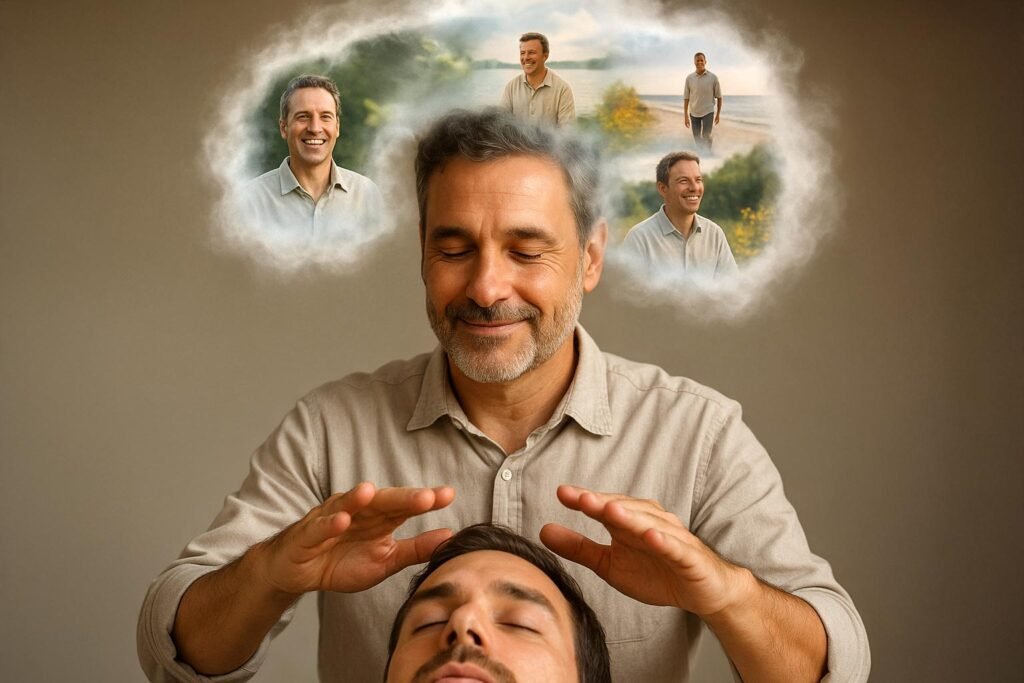
- Image Cycling: This is the central mental technique of the method. It consists of mentally visualizing a sequence of personal images at ultra-high speed resources.soundstrue.com. First, you create a list of ~20 things you desire—concrete, specific goals that you do not yet possess (for example: “I see myself driving my new car,” “I see myself healthy and active climbing that mountain”) bengstonresearch.com. Each item on the list must be something selfish (a desire of yours, not someone else’s) and recognizable when fulfilled. Next, transform each desire into a vivid mental image representing the outcome already achieved (like a mental snapshot of the fulfilled goal) medium.com. Memorize these images until you can recall them without assistance (tips for this will be provided later). Cycling itself involves moving through all the images on the list mentally, in a continuous loop and increasingly faster, like a fast-forwarded movie or a deck of cards being rapidly flipped through. With practice, this sequence reaches such a high speed that the images become a mental blur, occurring in your mind almost subconsciously. This technique generates a distinct mental state, uniquely increasing brain activity and apparently facilitating the healing connection. In summary: image cycling is like spinning a “carousel” of desires in your mind at high speed, fueling the healing energy.
- Posture and Physical Preparation: While there are no overly rigid rules regarding posture, it is important to create a comfortable position and environment for practice, especially at the beginning. It is recommended to sit or lie down with your spine straight, in a quiet location free from distractions. Keep your shoulders relaxed and take a few deep breaths to calm your mind before beginning. If applying healing to yourself, place your hands on or near the targeted area of the body (such as the abdomen or chest) in a relaxed manner. When applying it to someone else, ask them to sit or lie down comfortably; then gently place your hands on the affected area or on their shoulders (always with permission). There are no rigid hand positions like in other practices—what is essential is that you are comfortable, present, and have your hands available to feel any heat or tingling. Avoid crossing your arms or legs (so as not to “close off” energy flow, according to some traditions) and keep your feet flat on the floor if seated, helping you feel grounded. In short: a relaxed yet attentive posture, with light hand contact and a stable body. This allows you to sustain the practice for as long as necessary without physical discomfort.
- Intention Without Attachment (Detachment from the Outcome): This principle is foundational to the Bengston healer’s mindset. It means directing a clear healing intention, yet without becoming fixated on or anxiously yearning for the result. It sounds contradictory, but it is crucial: you sincerely wish for improvement (your own or another’s), yet during the application you release any expectation or pressure for it to “work.” This “detached intention” fosters an open, light mental state that supports the flow of energy. In practice, when beginning a session, set the intention mentally or verbally (for example: “may this session bring relief and healing to myself/so-and-so”) and then let go of that concern—focus solely on the process (the images, the sensations), not the goal. Bengston observed that he achieved his best results precisely when he was not obsessed with success (in fact, in his first experiment he had already given up hope when the tumors vanished oncampus.sjny.edu). In other words, avoid “forcing” the healing; maintain a sense of calm trust. Remember: you are a channel through which healing occurs, not its controller. Do your part (intention + technique) and allow the outcome to manifest in its own time. This detached approach also reduces practitioner anxiety and helps keep the mind playful and in flow, which—according to Bengston—is a decisive factor for success (bengstonresearch.com).
3. Mental Training and Progressive Visualization
Now that you understand the fundamentals, it is time to train your mind to cycle images with speed and fluidity. Like any skill, this requires consistent and progressive practice (resources.soundstrue.com). Below, we outline gradual exercises to develop everything from basic visualization to ultra-fast cycling. Follow them in order, dedicating enough time to each step before moving forward.
- List Preparation and Vivid Visualization: Start by defining your list of ~20 specific personal desires (as guided in the previous section). Exercise: Set aside time for each item on the list and visualize it in detail. Close your eyes and imagine the scene of the fulfilled desire as if it were happening right now—engage all your senses: see colors and shapes, hear sounds, smell scents or feel associated tactile sensations, and above all, feel the positive emotion it brings youmedium.com. For instance, if an item is “traveling to Japan,” visualize yourself walking through a Tokyo market, or savoring authentic sushi, experiencing the excitement and joy of that moment. Do this slowly, spending about 5–10 seconds on each imagemedium.com, until you feel “butterflies in your stomach” or a surge of joy—this is the sign that the image is emotionally charged. Go item by item, cultivating this intimate connection. This process not only motivates you, but also engraves the image more deeply into memory (a living memory, embodied rather than merely intellectual)medium.commedium.com. Tip: You will know you have visualized well when each evoked image triggers a genuine emotional reaction in your body (a spontaneous smile, a warm heart, etc.)medium.com. This emotional bond will make memorization much easier and the technique more effective.
- Memorizing the List: After experiencing the images, commit to memorizing all items in order. Some may come easily, while others will require repetition. Exercise: Write down your numbered list from 1 to 20. Try reciting it from memory, quickly visualizing each scene. If you get stuck on an item, look at your notes, recall the image with its emotional details, and try again. Keep going until you can recall all 20 images without peeking. This can take days—be patient. Remember that there are different levels of memorization: “Qi” memory (superficial recall) and “Blood” memory (engraved so deeply that it flows automatically). Aim for the latter: you should know your list as well as your own name. A fun tip is to deliberately scramble the order: try recalling the items out of sequence (in any random order)—if you succeed, it’s a sign that you genuinely master each image in isolation, not just the rote sequence. Mentally reviewing the list once a day helps lock it in (such as upon waking or before going to sleep). If you experience extreme difficulty memorizing (due to stress or age, for example), do not be discouraged—you can keep the written list nearby at first and glance at it quickly during practice (medium.com). With daily use, you will eventually memorize it naturally.
- Slow Rhythmic Cycling: With the list memorized, we begin the actual cycling. Exercise: Sit comfortably, relax, and begin running mentally through your images in sequence, but at a slow and steady pace. For example, one image per second—you can even use a clock or a metronome to mark the seconds initially. Another useful technique is to snap your fingers or tap lightly on the table with each image, like a drumming rhythm that sets the tempo. This helps engage the body and establish a cadence. So: image 1 (tap, or say “thump”), image 2 (tap again), image 3, and so on until the last, looping back to the first. In the beginning, it is normal for the mind to wander or hesitate—if you notice you forgot an image along the way, check your list, reinforce it, and start over. Practice this way for 5 minutes, completing as many cycles as possible within that timeframe. For the first few days, keep your eyes closed to focus internally. As you get the hang of it, try it with your eyes open as well (since the goal is to be able to cycle even while performing other activities). Objective: get used to moving through all the images without pausing, in a continuous, rhythmic flow. Once you can achieve this, move on to the next step.
- Gradually Accelerating Speed: Now you will train to increase the speed of your cycling over time. The concept is simple: progressively reduce the interval per image. Exercise: If you were doing ~1 image/second, now try 2 images per second (two per beat or two per breath). You can continue using a rhythmic pacer—for example, if you are tapping your fingers, now try visualizing two images every time you snap your fingers instead of one lornebrown.com. Do not worry about “seeing” each image clearly at this stage; you may only catch a quick glimpse of each one. Keep practicing this daily, ramping it up as you feel able: 3–4 images per second, then more. After a few days, your mental images will begin to blur—this is a good thing! Do not try to slow down or make the image sharp; let them fly by quickly. Tip: One way to gain speed is to get “you” out of the way—do not narrate or analyze the images, just let them pop up on their own. It is like learning to type fast: at first, you think about each letter, but later your hands move automatically. Here, train until the sequence “fires” on its own, with almost no conscious effort. It may take weeks to reach hundreds of images per minute, but persist—Bengston reports that advanced practitioners can cycle “hundreds of images per second” in their minds (resources.soundstrue.com), which seems unimaginable at first. The key is daily consistency: with every session, push your speed limit just a little bit further.
- Using Creative “Gimmicks”: To help accelerate the process and make it feel more natural, Bengston suggests using playful mental tools—dubbed gimmicks. These are creative strategies for visualizing images at high speed. Choose a metaphor that appeals to you: it could be imagining your images affixed to a strip of motion picture film spinning through a projector, or on a viewing cylinder (like a zoetrope) revolving, or even each image on playing cards rapidly being riffled through like a trick deck (lornebrown.com). Any device that shuffles and presents the images quickly and in random order will do—you could even imagine tossing all 20 pictures into the air as they swirl around you. Exercise: Incorporate your gimmick: visualize your images arranged on this imaginary medium and spin it. For example, suppose you chose the deck of cards: mentally place each image on a card, shuffle them thoroughly, and then riffle through the entire deck in 1 second, so that all the cards/images flash past your mind’s eye in a blur. Or, in the case of the film, pull the strip and spin it hard so the frames become a blur. Initially, try to complete a full loop of all 20 images in 1 second. Repeat several times. It doesn’t matter if an image gets “skipped” or out of order—in fact, the more random and chaotic the sequence, the better, as this prevents your rational mind from interfering. As you practice, try to spin even faster—two loops per second, three loops per second… The ideal outcome is that you cannot clearly distinguish any individual image during cycling; they merge into a continuous stream. At this point, the specific emotional and sensory content of each image no longer surfaces consciously—and that is completely fine, since that emotional charge was part of the preparation, not of the cycling itself. Speed matters: one of the goals is to reach hypercycling, a state of mental whirlwind where your conscious mind “releases control” and the process runs in the background (lornebrown.com).
- Verification and Fluidity (Flow State): As you reach very high speeds, it is useful to check whether you are still effectively cycling (without skipping any image mentally) and to cultivate the flow state. Exercise: During a rapid cycling session, “hit the brakes” suddenly—stop the sequence abruptly and see which image pops spontaneously into your mind at that exact moment (lornebrown.com). If it is truly random (that is, any item on the list can appear out of order), it is a sign that you were not consciously controlling the sequence, but that it was unfolding on its own—perfect, you are genuinely cycling. If, on the other hand, you always know which one comes next or land on the same image every time you stop, you may still be anchoring your mind to the memorized order; in that case, return to the exercises for randomizing with gimmicks and try to let go more. Another aspect: as you become proficient, try to cycle while doing other light activities, simulating use in real-life situations. For instance, put on some gentle music and cycle mentally to its rhythm, or walk slowly in circles while cycling. Initially, this is difficult (attention splits), but over time you will be able to keep cycling running in the “background” of your mind. The ultimate goal is to enter a flow state, where you cycle without conscious effort while simultaneously staying present in the moment (conversing, listening, or administering healing with your hands) resources.soundstrue.com. It is similar to driving a car while holding a conversation: part of you drives on autopilot. Once you reach this stage, congratulations—you have mastered the core skill of the Bengston Method. From there, continued practice will only make the process even more automatic and potent. Remember that this mastery takes time and regular practice—do not rush to “get there”; every training session already yields benefits (many people even report that items from their list begin to manifest synchronistically throughout the training bengstonresearch.com).
4. Daily Practice: 30–60 Day Learning Plan
In this section, we offer a structured daily plan to guide you through your first 30 to 60 days of practice, gradually incorporating both theoretical and practical elements. The plan is organized into weekly phases, each with a specific focus: starting with self-therapy (healing on yourself), then practice with objects and the environment, and finally application on others. Adjust the duration to suit your own pace—you can extend each phase for a total of 60 days, or condense it to around 30 days if you have more daily time available or already possess prior visualization experience. What matters most is to practice every day, even if only for a few minutes, as daily consistency drives exponential progress. Use this schedule as a guideline, but remain flexible: listen to your body and intuition, reinforcing steps whenever you feel the need before moving forward. Let us dive into the plan:
Days 1–14: Fundamentals and Self-Therapy (Healing on Yourself)
- Day 1: Reading and Initial Preparation. Dedicate the first day to understanding the basic concepts. Reread the introduction to this guide to absorb the history, principles, and evidence behind the method. If possible, watch an interview or lecture by William Bengston for inspiration (there are videos and podcasts recommended in the resources section). Next, begin creating your list of 20 desires: freely write down everything you genuinely want (remembering to keep them specific and not yet realized). Choose a notebook dedicated exclusively to this training and record your initial list there. Do not worry about finalizing it today—leave the list open for adjustments tomorrow. In the evening, do a brief meditation (5–10 min): sit quietly, take a few deep breaths, and visualize a calming light enveloping you. This helps you tune in to the journey ahead.
- Day 2: Refining the Image List. Review and finalize your list of desires. Ensure that all 20 items genuinely excite you—if any feels dull or overly generic, replace it with something that sparks passion. Make the descriptions very concrete (clearly imagine “the what,” without getting caught up in “the how/when”). Now, next to each item, describe the visual image that will represent that realized desire. For example: item “New cabin in the mountains”—image: “I see myself on the deck of a wooden cabin in the Alps, drinking tea and watching the snow fall.” Keep strictly one image per desire. Spend some time imagining each scene and write down key sensory or emotional details (this will help with memorization). By the end of the day, you should have all 20 images defined and written down on paper. Tip: Tonight, before falling asleep, reread the list and try to visualize it mentally as a whole to begin imprinting it into memory.
- Day 3: Intense Emotional Visualization. Today, focus on deeply experiencing each image. Sit unhurriedly and work through your list from item 1 to 20, visualizing slowly (5–10 seconds for each, or as long as feels pleasant) medium.com. Focus on generating the emotional response: joy, excitement, peace—whatever each fulfillment brings. If the emotion does not come, enrich the scene with more details or choose another angle that resonates more deeply with you. For instance, if “getting a new car” does not move you, imagine the freedom of the open roads you will travel in it, the breeze on your face—find the emotional core. Carry out this “immersion” with approximately 10 images from the list today (for example, items 1 to 10). Then take a break. In the evening, test your memory: try reciting those first 10 images mentally, seeing if you recall all of them in order. Relax—use repetition to anchor them, but without stress.
- Day 4: Memorizing the Full List. Repeat yesterday’s process for the other 10 images (items 11 to 20). Visualize each one slowly, with sensory details, until you feel the associated emotion. Now attempt to memorize the entire list (1–20). Use mnemonics if it helps—for example, tell a short story linking one image to the next, or notice if there is a natural sequence (sometimes one item complements another). Practice reciting them mentally several times. Tip: You can record an audio track listing the items in your voice and listen to it a few times to reinforce them. By the end of the day, try to visualize all 20 images in sequence without looking at the paper. If you succeed, congratulations—your list is ready to be cycled! If you still lack confidence, that’s fine: take the paper with you to the next step and consult it if you get stuck, but keep practicing the memorization over the following days.
- Days 5–7: Beginning Cycling – Slow Pace. In this several-day phase, you will begin the cycling practice itself, at a slow pace to get the hang of it. Suggested routine: Choose a time of day when you can dedicate ~15 uninterrupted minutes. Sit comfortably, take 2–3 deep breaths, and start mentally running through your list from start to finish on a loop. Day 5: Do this at a pace of ~1 image per second. You can use the ticking of a clock or even download a metronome set to 60 bpm to mark the seconds. Help yourself by counting “one, two, three…” and linking each number to an image in succession. At first, you will notice your attention wanting to wander—whenever you catch this, gently bring your focus back to the current image. Days 6 and 7: Try to increase the speed a little bit—for example, 2 images per second today (two per metronome beat). On Day 7, perhaps 3 per second if it feels comfortable. Don’t worry about being exact; the important thing is to pick up speed as you gain confidence. After each daily session, write down in your notebook how you felt: Was it difficult to keep up? Did any image stubbornly refuse to be remembered? Did you feel any physical sensation (warmth in the hands, tingling)? This journal will help you notice your progress. By the end of the first week, you should be able to cycle the complete list for several loops without looking at the paper, even if at a modest pace. Tip: Keep the practice playful—treat it like a game of memory and speed. Don’t get frustrated with missteps; laugh and start over. Bengston himself emphasizes that lightness is essential: “Above all, have fun! A playful approach… will take you far”bengstonresearch.com.
- Days 8–10: First Self-Healing Sessions. Now that you have some familiarity with cycling, it is time to apply it to yourself to feel it in practice. Routine: Choose a time when you are feeling relatively well. Day 8: Begin with a short session (~10 minutes) of laying hands on yourself. For example, if you have a specific pain or discomfort, place your hands over that area; if not, place one hand on your chest and the other on your abdomen (a general balancing position). Start the mental cycling (at whatever pace you can comfortably sustain; it doesn’t need to be super fast yet) and keep your hands still, tuning into any sensations. Stay there for 5–10 minutes. Don’t try to “make the energy happen”—just hold the intention that this exercise will do you good, and focus on the spinning images. Then wrap up, give thanks, and note how it went: Did you feel any change in your body? Did you relax, warm up, fall asleep? Days 9 and 10: Extend these sessions a bit, to 15 minutes. You can do one or two sessions per day on these days (morning and evening, for instance). Experiment with focusing on different goals: on Day 9, focus on a physical aspect (e.g., relieving discomfort or simply revitalizing your entire body); on Day 10, try focusing on something emotional (e.g., easing anxiety, or lifting your spirits). Always remember to cycle the images during the session—if you notice you stopped cycling because you got distracted, pick the images back up. By this point, your cycling speed may have already increased naturally—try speeding up whenever you feel it’s too easy. The important thing is to maintain fluidity without forcing it. You can also try cycling with your eyes open, looking at the ceiling or at your hands, to test your concentration. This first phase of self-healing gives you a reference point for what it’s like to feel like both healer and “patient”. Many beginners report sensations such as heat in the hands, pulsing where the hands make contact, mild drowsiness, or deep peace—notice what happens with you.
- Days 11–14: Consolidation and Automatic Fluidity. Halfway through the second week, your goal is to consolidate the practice before moving on to external work. Days 11 and 12: Focus on improving your speed and consistency. For instance, set aside a longer block of time today (20–30 min) and alternate exercises: 5 min of pure cycling (trying to hit your personal speed record—use a gimmick if you like, like imagining your deck of images spinning wildly), then 5 min of cycling during a simple activity (walking around the room, or slowly washing dishes), followed by another 5 min sitting and cycling with closed eyes, noticing the difference. Make the practice fun—come up with challenges, like “how many loops can I complete in 1 minute?” or “can I cycle while singing a song?” (these playful games prepare you for multitasking, making the cycling truly automatic). Days 13 and 14: Conduct full self-healing sessions of 20–30 minutes each. Treat this as your daily self-treatment: choose relaxing music if you like, lie down or sit comfortably, and place your hands wherever you intuitively feel the need (or perform a general scan, shifting your hands every few minutes to different parts of the body). Meanwhile, keep the cycling as fast and steady as possible. If your mind wanders, don’t blame yourself—simply return to the images. When finished, rest in silence for a few minutes, integrating the feeling. By the end of the second week, you should notice greater ease slipping into “cycling mode” (less conscious effort) and you may already have felt benefits: perhaps improved sleep, relief from some discomfort, or simply a sense of well-being after sessions. This initial confidence will serve as the foundation as we move forward.
Days 15–30: Practice with Objects and Environment
- Day 15: Healing on a Physical Object (Initial Experiment). In this new phase, we will extend the application of energy beyond yourself, starting with non-human objects or beings, which provide a middle ground before treating people. A common practice is “charging” water with healing energy. Take a glass or a pitcher of water. Sit with it between your hands (or wrap one hand around the glass and place the other underneath). Set the intention: for example, “I charge this water with healing energy to promote health and well-being for whoever drinks it”. Then, begin cycling images and keep transmitting for about 10 minutes. Visualize (if you like) vibrations or light flowing from the palms of your hands into the water. After the session, let the water sit. Note your observations (did you feel anything different while transmitting energy to the water? Did you notice warmth in the glass, or any interesting sensation?).
- Day 16: Observing Results in the Object. Today, examine the “treated object”. If it was water, try drinking it slowly, mindful of any difference in taste or effect (some report that energized water tastes slightly different or gives a sense of vigor). If you opted for another object (e.g., a stone, a crystal, or cotton—Bengston used treated cotton in experiments with diseased mice), spend some time holding it and see if you sense any residual energy. Write everything down. Tip: You can repeat the energizing process on the object again today to intensify the charge (for another 10 min). This experiment serves to refine your perception: objects have no mind or expectations, so you can practice total detachment—just deliver energy and see what happens.
- Day 17: Application on Plants. Plants are wonderful receivers of energy and provide visual feedback over time (growth, vitality). If possible, choose a plant you have at home—it could be a small potted herb, a flower, or even germinating seeds. Exercise: Conduct a 15-minute session sending energy to the plant. Place your hands around it (without squeezing) or lightly touch the leaves/pot. Perform mental cycling and imagine the plant absorbing a healing golden-green light. Maintain the intention of stimulating the plant’s vigor. After the session, water it if necessary and leave it in a good spot. Write down how it looked (appearance) beforehand. Day 18: Experimental Control: An interesting idea is to run a mini-experiment: if you have two similar plants, treat only one with the method and use the other as a control (it will receive no energy). That way, after a week you can compare whether there are differences in growth or appearance. So today, repeat the application on the same plant from Day 17, reinforcing it, while leaving the other without energy treatment. Take photos for future reference if you wish.
- Days 19–21: Consistent and Diversified Practice on Objects. Over these days, continue applying the method to different inanimate targets or animals, aiming to gain versatility. For instance, Day 19: Energize your food or drink before consuming it—hold the plate or cup and send energy for 5 minutes, noticing if the flavor or your sense of well-being after eating changes. Day 20: If you have a docile pet, try offering it a brief healing session (many pets love it and approach when they sense the energy). Make sure the animal is receptive—pet it while cycling the images mentally and observe its reaction (yawns, relaxation, purring in cats are all good signs!). Day 21: Try charging a personal object of yours, such as a necklace or stone that you can later carry with you. Spend 10 minutes performing laying on of hands on this object with the intention that it emanates balancing energy. Afterward, wear or carry it and notice whether you feel anything different while doing so. Throughout these days, also track the treated plants—record any positive change (a new leaf, greener color). All of this practice with objects and plants sharpens your energetic sensitivity and proves to yourself that you can direct energy outward. Additionally, by treating simple living beings (plants/animals), you gain the confidence to treat other humans.
- Days 22–24: Transition: Practicing at a Distance or in Real-World Situations. Now, begin preparing to treat people. A helpful intermediate step is practicing sending distance healing. Day 22: Think of someone you know who is in need of help (it could be an ill family member or a stressed friend). Ask for permission subtly (for example: “May I include you in my energy practices?”—briefly explain if necessary; many people welcome positive help). At the agreed-upon time (or if unscheduled, simply imagine the person receiving with openness), perform a 15-minute session as if the person were present: sit down, imagine the person or place a photo of them in front of you, position your hands as though they were over the photo/visualized body, and cycle the images while focusing on the intention of well-being for them. Day 23: Reach out to the person (if they know you sent it, politely ask how they felt around that time; if they don’t know, simply notice if they report any spontaneous improvement or difference). Don’t expect “proof,” but if they mention sleeping better or feeling an unusual calm, let that reinforce your motivation. Day 24: Try to cycle during a stressful everyday situation to see how the energy works in real time—for example, if a headache comes on or you feel impatient in a line, start cycling your images for a few minutes and notice if your state improves. This practice shows you that the technique can be integrated into daily life, not just used in formal sessions.
- Days 25–27: Preparing to Heal Others (People). By now, you should feel confident about applying the method on another person in person. Use these days to plan and prepare for it. Day 25: Identify someone close to you who is willing to receive a session—explain that you are learning an energy technique and offer a complimentary session. It can be a relative or friend with back pain, migraines, anxiety, etc. Schedule a day and time. Day 26: Review the fundamentals: reread the section on foundational techniques and ethics (Section 6) to ensure you are well aligned. Also prepare the environment: choose a quiet place, with a comfortable chair or massage table/mat. Set up some soft music if you see fit, and have water on hand to offer afterward. Day 27: Self-Affirmation and Centering: It is common to feel a bit insecure before treating someone for the first time. Take a few minutes to meditate and affirm yourself: recall the successes you have had so far (perhaps your own improvement or signs in the plants/objects). Affirm: “I am a channel for healing, I trust the process, I do my part, and I surrender the rest.” This helps establish a calm confidence within yourself.
- Day 28: First Session on Another Person. The moment has arrived! Welcome your “client” (friend/family member) calmly. Briefly explain what you will be doing: ask them to sit or lie down, tell them you will gently place your hands on them, and that they can just relax (they may close their eyes if they wish). Clarify that they do not need to believe or do anything special—just remain receptive. Begin the session: Position your hands where appropriate (usually on the back, shoulders, or near the problem area, always respecting personal boundaries). Start your image cycling internally and sustain it throughout the entire session. You will likely be conscious of both the person and the images—if you notice your attention drifting too much toward the person (e.g., “Is this working?”), gently return your focus to the images that continue spinning. Duration: 20 minutes is a good starting length. Stay attentive to any signs from the recipient: deepening breath, stomach rumbling (a parasympathetic relaxation response), muscles releasing tension, or even dozing off—these are indicators that the energy is taking effect. Closing: Once the time is up, gradually slow down the cycling and gently remove your hands. Let them know you are finished and ask how they feel. Do not be surprised if the person reports intense heat coming from your hands or tingling sensations—this is common and validates your work! Thank the person for the opportunity and advise them to drink water and rest.
- Day 29: Follow-Up and Reflection. The day after the session, reach out to the person to check on their post-treatment condition. Did their symptoms improve? Did they feel relaxed or sleep better? Record everything in your journal. Use this feedback as a learning opportunity: if there was improvement, it is encouraging; if there was no change, do not be disheartened—sometimes multiple sessions are required, or the benefit may be subtle (for instance, the pain did not disappear, but the person feels more hopeful). Also conduct a self-evaluation: How did you feel during the session? Were you able to maintain cycling smoothly? Did you feel any intuition or “pull” to place your hands in a certain spot? Did you notice fatigue, or did you feel energized afterward? Write it down. This reflection is invaluable for refining your technique in future sessions.
- Day 30: Recharge and Final Adjustments of the First Phase. Congratulations on reaching Day 30! Take today to consolidate your personal practice. Treat yourself to a good self-healing session or meditate in silence, giving your mind and body a well-deserved rest (after all, you have practiced extensively over the past few weeks). Review your journal entries from Day 1 onward and see how much progress you have made—this boosts confidence. Update your list of images if you feel called to do so: sometimes, after a few weeks, you may have fulfilled a desire or shifted priorities (feel free to swap out items on the list—it is fluid lornebrown.com). Ensure your current images still evoke emotion; remove any that no longer resonate. Mentally prepare yourself for the next stage (Days 31–60, if you choose to continue): the goal now is to expand and deepen everything you have learned, working with more people and honing your mastery.
(If you choose a 30-day plan only, consider that by this point you have acquired a solid foundation. You can continue practicing regularly on your own, following the guidelines you have learned, and perhaps revisit certain phases to hone your skills. However, for more advanced mastery, we recommend extending the training to 60 days as outlined below.)
Days 31–45: Advanced Application on Others (People)
- Days 31–33: Series of In-Person Healing Sessions. Over the coming days, aim to conduct more healing sessions on others to gain experience. Ideally, schedule 2 or 3 sessions during this two-week stretch. These can be follow-ups with the same person from Day 28 (multiple sessions generally amplify results), or new volunteers with different complaints. Day 31: Do a second session on the original person or someone else—notice how much easier it is than the first time, since you already know what to expect. Try increasing the duration to ~30 minutes if the previous one went smoothly. Day 32: A day of rest or self-healing so you do not overburden yourself (especially if you did sessions on back-to-back days). Day 33: Perform another session on someone—try applying it to a different case, for instance, if it was physical pain before, perhaps now someone with insomnia or anxiety, to see how the technique adapts. Always maintain ethics: ask for consent, explain things in accessible terms, and never promise an outright cure—tell them it is a complementary approach that may help.
- Days 34–36: Developing Sensitivity and Intuition. As you perform more sessions, start paying attention to subtler energy cues. Day 34: During a session (or even while practicing on yourself), try to sense the energy with your hands before you begin cycling: hold your hands a few inches away from the person’s body or your own arm, and feel whether any area is “hotter” or “colder,” or if there is a magnetic pull. This energetic sweep sometimes highlights spots that need attention. Then apply the healing as usual. Day 35: Talk to your recipient after the session and ask if they felt anything while you worked (they often report intense heat in a specific spot, or vibrations). Compare that with what you felt. This helps fine-tune your sensitivity and confidence—for example, if you felt a tingling in your left hand and the person says, “Wow, my left knee got super hot,” you gain confidence that you picked up on something real. Day 36: Explore intuition and visualization during the session: while cycling, your unconscious mind may occasionally send seemingly random images or thoughts (for example, you think of water while treating someone). Instead of dismissing them, take note and then, if appropriate, ask the recipient if that resonates (“Do you happen to have been drinking very little water lately?”). Do not be surprised if there are correlations—by entering a flowstate, your mind can tap into helpful intuitive insights. This is not the main focus, but it can develop as a beneficial side effect of your practice.
- Days 37–39: Distant and Group Healing. Now push your boundaries: Day 37: Try organizing a live distant session —unlike the blind send on Day 22, arrange here to connect with the person at the exact same time. For example, call a friend via video or phone, have them settle in while you also get ready, and let them know you will be in silence sending energy for 15–20 minutes. Leave the call running (no need to speak) or simply agree on a start and end time. Cycle through your list and imagine your hands touching the person or sending energy across the distance. When you finish, check in with each other—this can be quite impactful, as the person far away often feels as though you were right beside them! Day 38: If the opportunity arises, try a paired or group healing: for example, if you know someone else who practices (or even a curious friend), do a session together for a third person or on each other. Multiple intentions united can amplify the energy. You can place one hand and the other practitioner can place another on the ailing person, with both of you cycling through your lists (they do not need to be the same list—each does their own). Observe the synergy. Day 39: Use this day for rest and integration —when working intensively with energy, it is also essential to recharge. Take a relaxing bath, do gentle stretching or yoga, and get plenty of sleep. Let your mind “digest” everything you have experienced over recent weeks.
- Days 40–45: Refinement and Final Adjustments. In this final stretch of this phase, consolidate everything you have learned and tailor it to your personal style. Day 40: Take stock —in your journal, write down which techniques and variations worked best for you. For example, did you find cycling easier using a specific gimmick ? Which rhythm or setting puts you most into flow? Any preference for music versus silence? Clarifying this helps you replicate your optimal state. Day 41: Update your wish list again. Now that time has passed, perhaps some wishes have come true (who knows, small manifestations may have already occurred) or others have become less meaningful. Keep the list fresh and motivating (bengstonresearch.com). This refresh injects novelty, preventing the practice from falling into monotony. Day 42: Skill Test: Challenge yourself to cycle in an unusual setting to gauge your fluency. Example: try cycling through your mental images while watching something on TV (at low volume) or while reading a simple text. If you can pull it off, it means your subconscious is already cycling autonomously—a strong sign of mastery. Day 43: “Intuitive” Healing Session: Conduct a session (on yourself or someone else) where, beyond cycling, you allow your intuition to guide you completely—move your hands if you feel called to, adjust the speed of the images based on what you sense, and experiment with weaving in a prayer or mantra if that feels right to you. Observe whether this enhances efficacy or connection. Day 44: Revisit the theory: reread sections of this guide or the book The Energy Cure (if you have it) to see if you understand things on a deeper level now that you have practiced. Many puzzle pieces will fall into place much better after hands-on experience. Day 45: Wrap up this phase with another session on someone else (or on yourself, if you prefer), applying all the refinements you have cultivated. When you finish, celebrate your progress so far—you are already capable of using the Bengston Method with moderate confidence across diverse situations!
Days 46–60: Deepening, Mastery, and Integration
- Days 46–50: Taking the Technique to the Next Level. In this phase, you will strive for maximum mastery of the technique and begin fully integrating it into your lifestyle. Day 46: Focus on extreme speed (Hypercycling). Return to the acceleration drills: perhaps use a new gimmick to keep things fresh (if you used the deck of cards, try the film reel now, or a spinning Ferris wheel bearing your images). Push yourself to reach a point where you truly cannot count how many images are flashing by per second—it becomes a continuum. Notice the physical sensation of cycling this fast: some practitioners report a strange euphoria or a mental “click” when they enter this state. Day 47: Randomness Drill: Practice the “stop and check” repeatedly—accelerate as fast as you can for a few minutes, then stop abruptly and see which image appears. Do this 10+ times; if you spot any repeating pattern, try shuffling your mental list even more thoroughly (imagine tossing all the images into the air and letting them land in random order). The goal is to ensure that your conscious mind does not interfere at all. Day 48: Extending Duration: Try to carry out a very long continuous cycling session, say 1 uninterrupted hour of cycling (this can be during a walk or while doing light chores). This builds your mental endurance for staying in the flow. If you succeed, you will notice a point where you “forget” you are cycling—it just happens on its own. That is the goal! Day 49: Challenging Case Healing: If the opportunity arises, try applying the method to a tougher or unconventional case—for instance, someone dealing with a serious chronic condition, or even self-healing a deep-seated emotional aspect of your own. Observe how the technique navigates challenges—remain detached from the outcome, but take note of any subtle shifts. Even if there is no total resolution (which would be asking too much in a short time frame), watch for positive secondary effects, such as stress relief or better sleep for the client, signaling that the energy is working wherever it can. Day 50: Sharing and Community: Seek connections with other practitioners—for example, join online forums or groups (there are international Bengston Method groups on social media). Sharing your experiences and reading about others’ will both validate what you have experienced and offer new ideas and motivation to keep growing.
- Days 51–55: Cultivating Energy Sensitivity and Full Confidence. By this point, beyond technical skill, you should consolidate your energy perception and self-confidence. Day 51: Perform specific exercises for energy sensitivity: for example, rub the palms of your hands together for 15 seconds and then slowly bring them close together, feeling the “bubble” of energy between them. Expand and contract your hands to feel the resistance. This type of exercise (common in practices like Qigong) increases your awareness of chi. . Day 52: Dan Tien Meditation: Sit and concentrate for 10 minutes on the point two finger-widths below your navel (the body’s energy center). Visualize a small ball of light pulsating there. This helps ground your energy and recharge your internal “battery,” which in turn makes you a stronger and more resilient healer. Day 53: Reread your practice journal from the beginning and make a list of achievements: e.g., “I heal my own headaches in 10 minutes,” “Plant X has become lusher,” “My friend reported back relief after 2 sessions,” “I can cycle even while doing laundry.” Seeing how many positive things have occurred will enormously boost your confidence. Day 54: Volunteer Sessions: Consider offering a free session to someone in need outside your inner circle—for example, an acquaintance of an acquaintance who is dealing with an issue. This experience of helping altruistically reinforces your sense of purpose and confidence that you can make a difference. Day 55: Gather Feedback and Testimonials: Ask a few of the people you have worked with to write a brief note about what the experience was like for them. Having testimonials (even informal ones) is rewarding and solidifies in your mind that the method is effective. (Save these accounts—you might want to pursue this professionally in the future, and they will be useful.)
- Days 56–60: Ethics, Continuous Evolution, and Next Steps. In the final days of our plan, we will reinforce an ethical posture, ensure the sustainability of your practice , and look ahead to future paths. Day 56: Carefully review Section 6 (Practitioner Ethics) below. Reflect on each point and assess whether your actions so far have been aligned. For example, have you been properly obtaining consent? Have you made it clear that you are not a physician and that people must continue their conventional treatments? Have you set boundaries so as not to burn out? If anything needs adjustment, plan how you will do things differently going forward. Day 57: Healer Self-Care: Today, focus on nourishing yourself. Do something that recharges your spirit—a walk in nature, engaging in your favorite hobby, or receiving a therapy session yourself (massage, Reiki, etc.). Healers need to be cared for, too. By keeping yourself well, your ability to help others only grows. Day 58: Think about the future of your journey with the Bengston Method. What are your goals? Perhaps diving even deeper (for example, by attending an official workshop with Bengston), integrating this technique into your current profession (e.g., as a therapist, psychologist, or massage therapist), or simply using it quietly to benefit family and friends. There is no right or wrong path—write down what would make your heart happy. Day 59: Keeping the Practice Alive: The greatest risk after completing any training is letting the practice fade away. So, plan your post-course routine: How many times a week do you intend to practice? (Ideally, a little bit every day—for instance, cycling through your images every night when you go to bed until you fall asleep, keeping yourself sharp). Think of ways to make it natural—post reminders, link the practice to daily habits (e.g., cycling whenever you are in the shower or stuck in traffic). Remember Bengston’s words: avoid falling into ritualistic rigidity; keep the practice flexible and fun, adapted to your life bengstonresearch.com. Day 60: Final Evaluation and Celebration: Conduct an honest self-evaluation. Compare that “you” from Day 1 (who knew little about the method) with the practitioner you are today, 60 days later. There has undoubtedly been tremendous growth—not just in technical knowledge, but in self-confidence, and perhaps in your worldview (you have witnessed things that previously would have seemed like “everyday miracles”). Acknowledge this growth and celebrate! You might mark the day with a small ritual of gratitude: thank yourself for your commitment, thank any “unseen masters” of energy you may believe in, and thank the people, plants, and animals that trusted you to receive it. The formal learning journey ends here, but a new path of personal exploration continues ahead. Consider yourself now a Bengston Method practitioner, capable of helping both yourself and others. And like any good practitioner, always keep a curious and open mind to learn more from every experience—after all, as Dr. Bengston himself acknowledges, no one holds the whole truth about healing; we are all continually exploring and evolving bengstonresearch.com.
5. Tips for Developing Energy Sensitivity and Confidence
In this section, we list some extra tips to help you hone your perception of energy and build confidence in your healing abilities—important qualities that develop with time and attention.
- Pay Attention to Subtle Sensations: Whenever you practice (whether on yourself, objects, or people), keep an “internal antenna” tuned to notice any physical or energetic sensation. It could be heat or tingling in your hands, sensations of pulsing, lightness, or pressure in certain parts of the body, goosebumps, or waves of heat or cold running through the receiver’s body, etc. Initially, these sensations may be faint, but as your sensitivity grows, they become more pronounced. Recognizing these signs reinforces your confidence that “something is happening.” For example, many practitioners report feeling intense heat in their palms when offering healing, sometimes accompanied by redness—a classic indicator of flowing energy. If you notice something like this, write it down and value it—it is your perception awakening!
- Engage in Other Energy Practices: Any activity that cultivates vital energy will complement the Bengston Method and heighten your sensitivity. Consider incorporating Qigong, Tai Chi, or Yoga into your routine a few times a week. These practices teach you to move and feel chi within your own body, sharpening your senses. Chakra meditations or aura visualization exercises can also expand your ability to perceive energetic fields. Remember: the more you “speak” with energy in different languages, the more fluent you will become.
- Keep a Progress Journal: Documenting your experiences is vital. Keep a journal (as suggested in the schedule) where you write after each session: what you did, what you felt, and what the receiver reported. Over time, reread these notes—you will see a catalog of personal evidence that energy works and that your perceptions have sharpened. This concrete record combats any doubts that arise on off days, serving as a reminder of the breakthroughs and sensations you have already achieved.
- Start Small, Celebrate Small: To build confidence, achievable goals are the secret. Instead of immediately trying to heal something very complex, start by applying the technique to minor, easily measurable pains or issues . For example, try to relieve your own mild headache, reduce anxiety before an exam, or calm your agitated cat. When you achieve success in these cases (even partial), celebrate! Put a ✓ in your journal, share it with an understanding friend. These small victories build conviction within you. That way, when you face bigger challenges, you will have a solid internal foundation of “I can do this” to lean on.
- Seek Honest Feedback: When treating others, encourage honest and open feedback. Explain that you are refining the technique and would love to know what they felt during and afterward. Not every recipient will feel something dramatic, and that is completely fine—but at times you will be surprised by reports of intense sensations or improvements that validate your work. Collect these stories. For instance, if someone says, “I don’t know what you did, but my pain was gone for two days after that session,” commit that to memory (or better yet, write it down in their exact words). This kind of feedback fuels your confidence during moments of doubt.
- Trust the Technique—and Yourself: Remember that the Bengston Method has been successfully replicated by many people, including skeptical practitioners and beginners oncampus.sjny.edu. This means that there is no reason why you cannot do it too. Keep this in mind on days when you second-guess yourself. The underlying science may still be emerging, but the practical results speak volumes. Trust the process you followed—the technique works, even if you do not fully understand it. And trust yourself as a practitioner—you have dedicated time and heart to learning, so you deserve to believe in your own potential. This confidence (which is not arrogance, but rather serene conviction) translates energetically to the recipient, making the healing even more effective.
- Maintain a Playful Approach: It might sound repetitive, but it is vital: do not take yourself or the practice too seriously. Excessive seriousness constricts energy, whereas joy and curiosity expand it. If you ever catch yourself feeling tense because you “have” to heal someone or overly anxious about the outcome, take a moment to pause and breathe. Remember Bengston’s advice: healing travels best through an attitude of playfulness and exploration bengstonresearch.com. Bring lightness to the table: if something isn’t working, laugh and tell yourself, “Okay, it’s being stubborn today; let’s try something different tomorrow.” Dance with the energy instead of trying to push it rigidly. This lighthearted mindset heightens your sensitivity (since you become more relaxed and receptive) and also strengthens your confidence, because you are not judging yourself over perceived failures—everything turns into a fun learning experience.
In short, cultivating sensitivity and confidence is a gradual process: it requires mindful practice, an openness to sensing the invisible, and positive self-reinforcement every step of the way. Over time, you will be amazed to find yourself noticing subtle energetic details that used to slip past unnoticed, and walking into every session with unshakeable faith in the healing power working through you. At that stage, you become an assured and effective healer, capable of imparting calm and certainty to those receiving your care as well.
6. Practitioner Ethics: Boundaries, Expectations, and Consent
When applying the Bengston Method (or any healing modality), upholding ethical principles is essential. This ensures safety, respect, and integrity both for you and for the recipient. Below are key ethical guidelines to keep in mind:
- Obtain Prior Consent: Never perform healing on anyone without their explicit permission. Even with the best of intentions, every individual has the right to choose whether or not to receive energetic interventions. Clearly and simply explain what you intend to do (for example: “May I place my hands on your shoulders for a few minutes to try to help with your pain, using an energy technique I practice?”). If the person is skeptical, emphasize that belief is not required to give it a try, but respect their feelings if they are uncomfortable—do not push. In the case of minors or pets, obtain consent from their parents or guardians. When sending healing from a distance, make every effort to get authorization as well; if that is impossible, a suggested ethical guideline is to send it with the intention that the energy be received only if it serves the person’s highest good —though when in doubt, it is always better to have the direct okay from them or their family.
- Clarify Its Complementary (Not Alternative) Nature: No matter how enthusiastic you are about the method’s efficacy, never advise anyone to abandon conventional medical treatments. Be explicit that you are not a physician (unless you are medically licensed, of course) and that your work is complementary. As Bengston himself underscores, the method is not a substitute for necessary medical or psychological care bengstonresearch.com. If you are working with someone who has a serious condition, encourage them to keep following their doctor’s orders and treat energy healing as an added layer of support. Avoid making absolute claims like “I will cure your illness”—this sets up dangerous expectations. Instead, say something along the lines of: “This technique may help support your recovery alongside your ongoing medical care. Let’s give it a try and see how you feel.” In doing so, you maintain honesty and humility, which are core ethical values.
- Establish Healthy Boundaries: As a practitioner, you must set clear scope-of-practice boundaries. Do not take on problems that exceed your capabilities or put you at risk. For instance, if someone with a severe mental illness comes to you asking to stop their medication in favor of energy work alone, do not entertain that idea —strongly urge them to maintain their professional care, and perhaps offer energy healing as supplementary support (and if you do not feel qualified, politely decline). Also honor your own physical and emotional limits: do not overbook sessions to the point of exhaustion; set a clear duration for each session (generally 20 to 40 minutes is plenty) and wrap up gracefully once that time is reached, even if the person wants to keep going (you can always schedule another day). Say “no” whenever necessary —it is far better than burning out and ultimately compromising your effectiveness or joy in the practice. Maintain professionalboundaries as well: avoid touching private areas of a client’s body (healing can be performed with hands held off the body without contact in those regions) and always conduct yourself with respect and propriety.
- Be Realistic About Expectations: Energy healing is rarely linear or predictable. Take care not to foster unrealistic expectations in others (or in yourself). If someone asks, “Can you cure my condition?”, an ethical answer would be: “There are positive reports in similar cases, but every body is unique. Let’s try a few sessions and see how you respond, without making any specific promises.” Make sure people understand that results may vary —some experience rapid relief, others gradual progress, and in some cases the effects may be more subtle (such as an improved sense of overall well-being, even if the primary condition persists). Emphasize that the two of you are collaborating on a healing journey, but that there are no guarantees; the outcome depends on many factors. This prevents frustration and maintains transparency.
- Maintain Privacy and Confidentiality: When someone comes to you for healing, they often end up confiding deeply personal matters (health history, fears, etc.). Keep this information in absolute confidence. Do not share details about a person’s condition with others without their permission. If you wish to discuss a case in a forum or study group, omit or alter any identifying information (or request their consent beforehand). This ethic of confidentiality fosters trust —the recipient feels safe enough to open up, which also enhances outcomes, as they can relax more deeply knowing they are in good hands.
- Act with Integrity and Humility: Remember that you are a facilitator, not an omnipotent “miracle worker.” Approach your practice with authentic humility . This also means recognizing when something is beyond your scope. If you notice, for example, that someone is placing their sole faith in you during a medical emergency, be firm in directing them to seek immediate medical attention. Or if someone asks you scientific questions you cannot answer, be honest enough to admit: “I don’t know exactly how it works—no one fully does—but there are studies and numerous documented cases showing that it does work. I’d be happy to share some reading material if you’d like.” Never be afraid to say, “I don’t know” or “I cannot promise that.” Being honest is preferable to falling into the temptation of playing the superhero. Ironically, this honest and humble posture increases your credibility and perceived ethics.
- Cultivate the Greater Good and Non-Maleficence: A basic ethical precept in healing (inherited from medicine) is “first, do no harm.”The energy itself tends to be self-regulating and beneficial, but attitudes can cause harm. Therefore, never use the technique to manipulate people or situations against their will (for example, do not put “so-and-so loving me” on your list—besides being unethical, it distorts the healing purpose). Always use your intentions to promote health, relief, and things aligned with the highest good of all. If at any point you feel tempted to cross an ethical boundary (e.g., continuing to treat someone who asked you to stop, or intervening without being asked), pause and reflect. Remember why you got into this: to help and alleviate suffering while respecting free will..
By following these guidelines, you will act as a responsible and ethical practitioner. This protects you (both legally and morally) and maximizes the benefit for those receiving your help. Remember: ethics and healing go hand in hand —the trust and peace of mind generated by ethical conduct even enhance the energetic effects, while a lack of it can block results. Therefore, incorporate these principles from the very beginning of your journey as a healer.
7. Resources and Sources for Further Study
Finally, we provide a list of useful resources —books, courses, articles, and online content—for those who wish to delve deeper into the Bengston Method. Whenever possible, we indicate materials in English accompanied by a brief description in Portugueseso that you know what to expect from each source.
- Book: “The Energy Cure: Unraveling the Mystery of Hands-On Healing” (William F. Bengston, 2010) — This is Bengston’s primary book , in which he chronicles his discoveries and explains the technique in detail. It includes the story of his scientific experiments with cancer healing in mice and anecdotal clinical cases. There is no Portuguese translation to date, but it is a must-read for enthusiasts (accessible language, blending science and personal accounts). In it, Bengston describes step by step how to practice image cycling and shares profound reflections on the nature of healing. For example, he explains that the technique does not require prior belief and that, in fact, “specific skeptics can play the role of the healer,”recounting how he trained skeptical volunteers to cure mice by visualizing their personal images oncampus.sjny.edu. This book will solidify what you have learned here, with a wealth of detail and evidence.
- Audio Course: “Hands-On Healing: A Training Course in the Energy Cure” (William Bengston, Sounds True, 6 CDs) — An audio course (in English) where Dr. Bengston himself teaches the technique in a guided manner, including practical exercises. It is a companion to the book, more instructional and interactive. You will hear Bengston guiding the listener through cycling sessions, offering pacing tips (he even uses tapping to help speed up the images), and sharing insights. Ideal for practicing along, as if you were in a workshop. Many find it easier to learn by listening to his voice, as it conveys the relaxed intonation he suggests (remember: a playful approach!). This course heavily reinforces the concept of a flow state: Bengston compares mastering cycling to mastering a sport, where with practice you reach a point of playing on “autopilot” and entering the flow (resources.soundstrue.com). A great choice if you learn better by listening than by reading. (Available on the Sounds True website or Audible.)
- Official Website – Bengston Research (bengstonresearch.com) — William Bengston’s official website provides a variety of information and updates. In the “Healing Method” section, you will find a summary of the method and its philosophy. There is also an FAQ page answering common questions (e.g., whether a special gift is required, if it works for disease X, etc.), a Publications section listing published scientific papers (for those who want to dig into the experimental data), and Interviews with links to his media appearances. The site also promotes in-person and online workshops conducted by Bengston—if you are looking for formal training, that is the place to check for dates and locations. Additionally, the Resources section contains articles and occasionally shares from practitioners. Although in English, the site is straightforward and can be translated via web browsers. A recommended read on it is the passage where Bengston emphasizes the experimental and non-dogmatic nature of the technique, encouraging practitioners to explore and even move beyond his teachings.
- Podcast Interview: “Exploring the Mystery of Hands-On Healing” – Tami Simon in conversation with William Bengston (Sounds True, Insights at the Edge) — An in-depth interview (in English), lasting ~1 hour, available in audio and transcript (resources.soundstrue.com). Bengston discusses his “incredible and documented” results and explains the cycling technique to the host, who asks insightful questions. It is great for hearing the explanations straight from him. For example, he mentions that during rapid cycling he visualizes “hundreds of images per second” of things he desires, and that this speed pushes the brain into a flow state. He also talks about “resonant bonding” —a potential connection or synchronization between healer and patient during healing. The interviewer expresses difficulty in imagining so many images so quickly, to which Bengston responds by comparing it to learning tennis or ping-pong: at first it seems impossible, then it becomes second nature. All in all, this interview adds context and several advanced details to his theory. You can download the transcript and translate it into Portuguese for easier reading.
- Article: “Breakthrough: Clues to Healing with Intention” – EdgeScience Magazine, no. 8, 2011 — An article written by Bengston himself, in which he presents lay audiences with some clues to intentional healing discovered throughout his research. He outlines the procedure used by volunteers (the list of 20 images, etc.) and discusses hypotheses, such as the idea of mind-body entanglement. This article is short and offers a taste of the results without overly technical jargon. A notable passage reads: “Each item on the list is translated into an image representing the achievement of that goal… the practitioner then practices cycling these images in a sort of mental loop… this technique, rather than slowing brain activity down as in meditation, actually speeds up brain functioning through rapid visualization” (oncampus.sjny.edu). It is in English, but it can be found online (by searching the title and Bengston) and translated. Great for sharing with skeptical friends, as it is concise and published by a frontier science magazine.
- Scientific Research (Various academic papers): For the scientifically inclined, Bengston and colleagues have published articles in journals such as the Journal of Scientific Exploration and the Journal of Alternative and Complementary Medicine. Examples include: “The Effect of the Laying On of Hands on Transplanted Breast Cancer in Mice” (W. Bengston & & D. Krinsley, JSE, 2000) — details the original experiment with cancerous mice and the outcomes of remission and immunity (a fantastic paper for viewing raw data and statistics). Another is: “Transcriptional Changes in Cancer Cells Induced by Exposure to a Healing Method” (Moga, Bengston et al., 2017) — an in vitro study showing genetic changes in cancer cells exposed to Bengston energy, pointing to biological mechanisms at work. These papers are in English and tend to be technical, but they are invaluable for anyone seeking documented evidence. The official website and platforms such as ResearchGate may host these PDFs. As you read them, note the skeptical and rigorous tone: Bengston emphasizes that even he was surprised and had to remain humble in the face of unexpected data, thereby fostering an open, scientific approach.
- Online Communities and Forums: After learning, it is very helpful to connect with other practitioners to exchange experiences, ask questions, and feel part of a community. On Facebook, there is a group called “Bengston Energy Healing Method” (mostly in English) where members share tips, clarify details, and even organize collective distant cycling practice. Forums on spirituality websites or Reddit (e.g., the subreddit r/energy_healing) occasionally discuss the Bengston Method—there are Brazilian users as well (there have been threads in Portuguese discussing the technique). Just use discernment when reading online reports—everyone shares their own experience, which isn’t always rigorously vetted, but the sense of community and support can be very motivating.
- Other Materials: It is worth mentioning that William Bengston also co-authored a book called “Chasing the Cure” (2009, with Sylvia Fraser)—which is more focused on the story of how he discovered and pursued healing (a sort of early autobiography). If you are interested in his personal journey and the behind-the-scenes aspects of the experiments, it makes for interesting supplementary reading (also in English). Additionally, there are interviews on YouTube, such as lectures he has given at universities and podcasts (for instance: New Thinking Allowed, Coast to Coast AM, etc.). A search for “William Bengston healing” on YouTube returns several discussions. Watching these interviews with subtitles (some have auto-generated subtitles that can be translated) can reinforce concepts—sometimes hearing the cycling explanation repeatedly helps you catch new nuances.
Sources used in this guide: During the preparation of this manual, we used information from the sources above and public domain materials. Citations in the format 【n†Ln-Lm】 throughout the text refer to specific excerpts from these sources to substantiate the information presented. For example, we directly quote Bengston’s statements and article excerpts to ensure accuracy (you can check each reference for further details).
In summary, there is a great wealth of material available to deepen your knowledge. After consolidating your basic practice with this guide, we recommend that you gradually immerse yourself in these readings and courses. They will bring new perspectives, advanced insights, and a sense of belonging to a global community of energy healing explorers. Have a great journey of continuous learning!
We hope this comprehensive guide has provided you with a solid foundation to learn and master the Bengston Healing Method. Remember that you can return to any section to review concepts and that true learning comes from consistent practice. With dedication, an open mind, and a light heart, you have a powerful tool in your hands to promote healing and well-being in yourself and others. Happy practicing! 🌟


Join the conversation
What did this article awaken in you?
Share your experience or ask a question. Your perspective is part of this conversation.