
In this article
Your Sun sign is a starting point. Your complete birth chart report brings in the rest of your birth sky: the Moon and rising sign, the planets, the twelve houses, their rulers, and the aspects connecting them. Together, these layers give you more to explore about your emotional needs, relationships, motivations, strengths, and recurring challenges.
At The Awakening Touch, you can create your free birth chart and sample reading first. The Complete Birth Chart expands that first look into a detailed English-language reading, with access through your account and a downloadable PDF you can return to at your own pace.
Here is what you will find inside, what each section adds, and how to get the most from your reading.
A quick look inside your complete birth chart
- Your personal chart wheel, aspect grid, and symbol guide: see the positions and relationships behind the interpretation.
- Planets and points in the signs: explore your needs, style of expression, motivations, and ways of responding.
- Signs on the house cusps: understand how each area of life is approached in your chart.
- House rulers: discover connections between different areas of life, including houses that contain no planets.
- Planets and points in the houses: see where the themes of each placement enter your experience.
- Planetary aspects: explore how different parts of your chart cooperate, challenge, and adjust to one another.
- Elements, qualities, and polarity: take a broader look at the balance of your chart.
- Your complete reading online and in PDF: move between sections and revisit the material when a theme becomes relevant.
The free sample already gives you a calculated chart and selected interpretations. The value of the complete report is the deeper interpretive reading across these sections. A known birth time is needed for the full set of time-sensitive placements, including the Ascendant and houses.
Your chart wheel, positions, and aspect grid
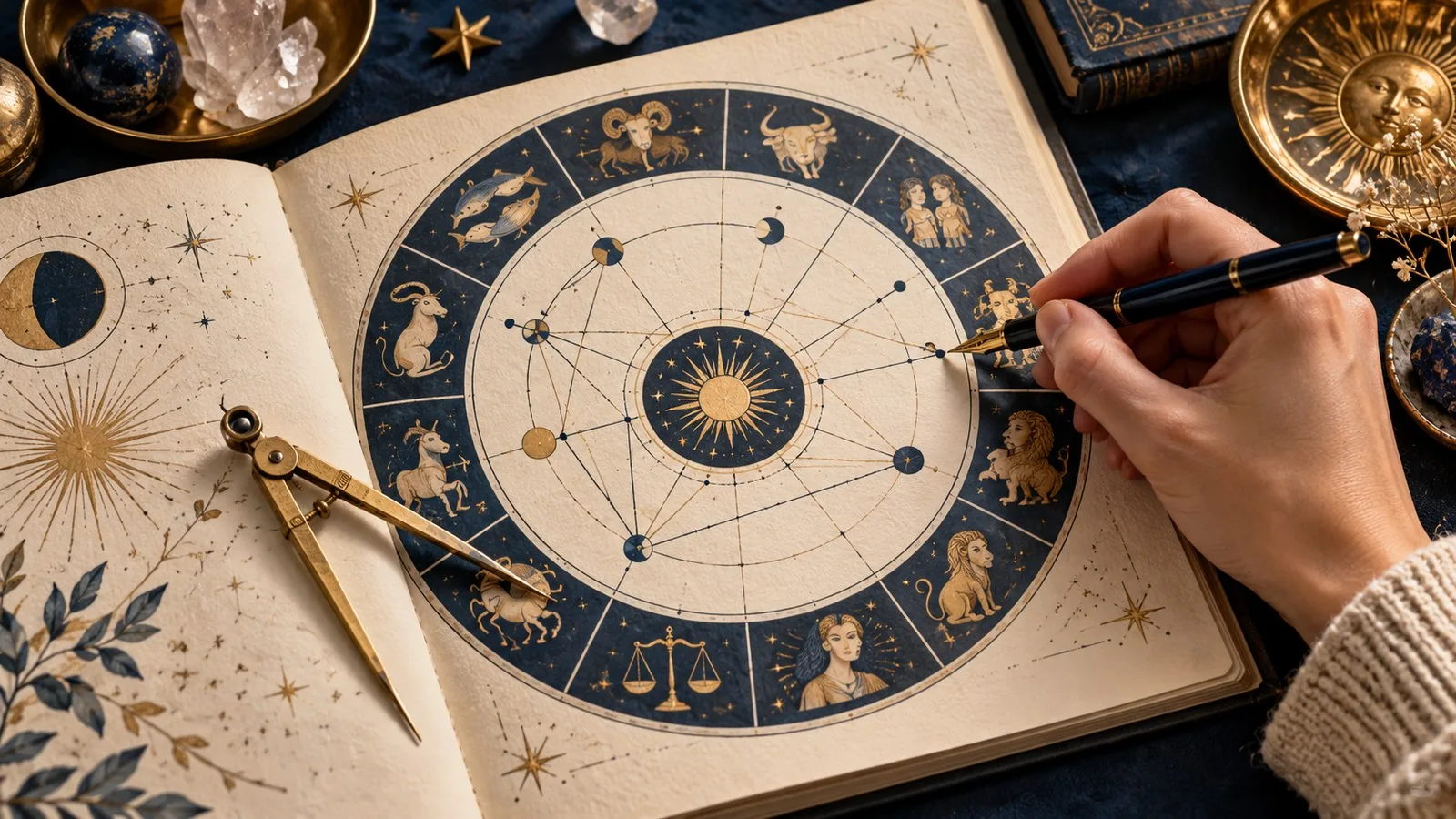
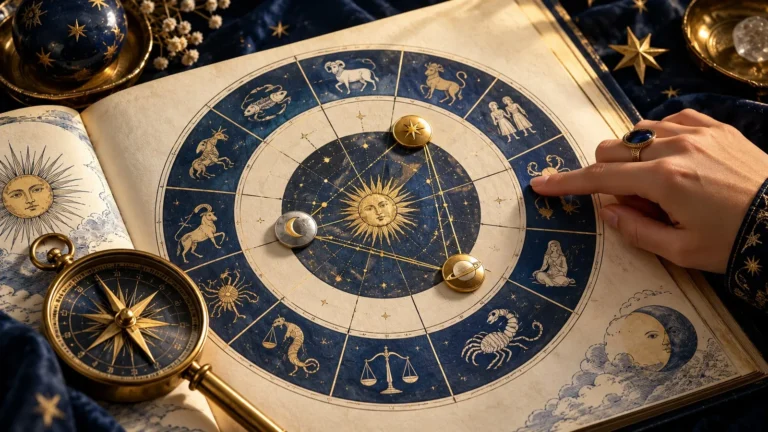
The chart wheel, also called the mandala, is the visual map of the sky at your birth. It brings the planets, zodiac signs, houses, and aspect lines into one view. The accompanying data and legend help you identify the symbols and connect them with the written reading.
The aspect grid gives you another way to see the relationships between chart points. You can use it alongside the aspect interpretations, rather than trying to understand every colored line at once.
Our calculator uses Swiss Ephemeris, the tropical zodiac, and Placidus houses. Your birth date, local birth time, and birthplace determine the calculation. The interpretations then explain the astrological symbolism of the placements found in your chart.
Planets and points in the signs: how you express yourself
This is where you move beyond a single zodiac label. Each planet or point represents a different part of the reading, and its sign adds a style of expression.
- Sun, Moon, and Ascendant: identity and direction, emotional needs, and the way you meet new situations.
- Mercury, Venus, and Mars: communication and thinking, affection and values, desire and action.
- Jupiter and Saturn: growth and meaning, responsibility and boundaries.
- Uranus, Neptune, and Pluto: themes of change, imagination, and transformation, considered within the rest of the chart.
The reading also includes additional points such as Chiron, Black Moon Lilith, and the lunar nodes. With a known birth time, it also includes the Part of Fortune, Vertex, and Midheaven. These are different kinds of astrological factors, rather than additional planets.
What this adds: a fuller vocabulary for experiences that a Sun-sign description cannot cover on its own. You may recognize one way of expressing affection and a different way of responding under pressure. Reading the placements together helps you explore that complexity.
For an introduction to the three most familiar placements, see our guide to Sun, Moon, and rising signs.
Signs on the house cusps: your approach to each area of life
A house cusp marks the beginning of an astrological house. The sign on that cusp adds another layer to how you explore the topics associated with the house.
These topics include personal identity, resources and values, communication, home and family, creativity, daily routines, partnership, shared responsibilities, learning, public life, friendships, and time for retreat. Your report interprets the cusp signs calculated for your own chart.
What this adds: a reading of all twelve areas, including those with no planets in them. An empty house still has a cusp sign and a ruler; it is not an absent part of your life.
House rulers: the connections you might otherwise miss
House rulers are one of the most useful ways to connect a chart. Start with the sign on a house cusp, identify the planet that rules that sign, and then locate that planet in its own house. Your report includes interpretations for these house-to-house connections.
For example, if the ruler of the second house is in the tenth, the reading connects second-house topics such as personal resources and values with tenth-house topics such as vocation, responsibility, and public contribution. It gives you a relationship to explore, rather than two disconnected descriptions.
The ruler of the first house, often called the chart ruler, offers another perspective on your Ascendant. Its location adds context to how you approach the world. The same method applies to the other houses.
For Scorpio, Aquarius, and Pisces, our framework includes modern and traditional rulers. You may therefore see more than one rulership connection for a house.
What this adds: links between the topics that matter to you. It can help you consider how your approach to partnership relates to another area of life, or how your priorities connect with your public role. A house ruler provides context; it does not guarantee a particular event or outcome.
Planets and points in the houses: where the themes come to life
The sign of a planet describes one layer of its expression. Its house places that symbolism in an area of life. The Complete Birth Chart includes a dedicated section for these placements.
Venus in a sign and Venus in a house answer different questions. The sign can describe a style of relating and valuing; the house adds the setting in which those themes are explored. The same distinction applies to the Sun, Moon, Mercury, Mars, and the other factors included in the reading.
What this adds: more personal context. You can connect a placement with topics such as learning, home life, creative expression, work routines, or partnership, instead of stopping at a general personality description.
House placements depend on the birth time and house system. They should be read alongside the cusp signs and house rulers, because each section contributes a different piece.
Planetary aspects: how the different parts of you interact
A chart becomes more connected when you look at the relationships between its points. Aspects are angular relationships, and the complete report interprets the relevant aspects found in your chart.
- Conjunction, 0°: factors brought closely together, intensifying or combining their themes.
- Sextile, 60°: opportunities for cooperation that you can choose to develop.
- Square, 90°: tension or competing needs that invite attention and effort.
- Trine, 120°: a more flowing relationship that may feel familiar or natural.
- Quincunx, 150°: a need for adjustment between different ways of operating.
- Opposition, 180°: a polarity to understand and balance.
The meaning depends on the planets involved and the rest of the chart. A Venus–Mars aspect, for instance, brings the themes of affection and desire into the same conversation. A Mercury–Saturn aspect raises a different set of questions about thinking, communication, and structure.
What this adds: a way to explore why two descriptions can both feel true, even when they seem to pull in different directions. Challenging aspects can point to areas for growth; flowing aspects can highlight capacities worth using consciously.
Elements, qualities, and polarity: the broader balance
The distribution summary helps you step back from individual placements and see broader patterns across the chart.
- Elements: Fire, Earth, Air, and Water.
- Qualities: Cardinal, Fixed, and Mutable.
- Polarity: the active and receptive groups of signs.
What this adds: a useful overview to compare with the detailed reading. You might explore a balance between initiating and sustaining, or between practical concerns and emotional responses. These distributions describe astrological patterns, not scores for how much of a human quality you possess.
A reading you can revisit online and in PDF
Your complete report is available through your account, with a downloadable PDF for reading offline and returning to particular sections. You can read in stages instead of trying to absorb the entire chart in one sitting.
A practical starting order is: your Sun, Moon, and Ascendant; planets in signs; house cusps and rulers; planets in houses; then aspects. Use the chart wheel and distribution summary as reference points along the way.
You can also follow our step-by-step birth chart interpretation example to see how selected placements can be connected in a reading.
Free sample or complete report: what changes?
| What you receive | Free sample | Complete Birth Chart |
|---|---|---|
| Birth chart | Your chart and birth data. | Your chart, with the full reading. |
| Reading | Selected passages. | The full set for your chart. |
| Coverage | An introduction. | Signs, cusps, rulers, houses, and aspects. |
| Full PDF sold separately. | Full PDF and account access. |
The number of interpretations varies with the chart. The sample shows the available reading and current offer for your own birth details, so you can decide whether you want to continue.
Create my birth chart and explore the free sample.
Before you create your complete birth chart
What information do I need?
Your name, birth date, local birth time, and city of birth. Use the place where you were born. Enter the recorded local time, taking care with a.m. and p.m.; the calculator handles the time-zone calculation.
What if I do not know my birth time?
Select the unknown-time option for a limited reading. The calculator uses noon as a reference and leaves time-sensitive interpretations out, including the Moon, Ascendant, Midheaven, Part of Fortune, Vertex, house placements, cusp signs, and house rulers. To get the most from the complete report, look for a reliable birth record first.
Does it include predictions for the year ahead?
The Complete Birth Chart focuses on your natal chart, calculated for your birth. For a reading of upcoming planetary movements in relation to that chart, explore Future Transits as a separate service.
Do I need to understand astrology already?
You can begin with the written interpretations and use the legend when you want to identify a symbol. Read a section, note what resonates or raises a question, and return to the chart when you are ready for the next layer.
Start with your chart. Choose how deeply you want to explore it.
Your Sun sign is one part of your birth sky. The complete reading adds the houses, rulers, planetary relationships, and other placements that make the chart more personal. It gives you material to revisit as you reflect on your choices, relationships, and ways of expressing yourself.
Explore my birth chart and the Complete Birth Chart offer. Start with your free sample, see the current price, and unlock the complete reading if you want to go further. After payment is confirmed, your complete report is available through your account.
Astrology is an interpretive tradition used here for self-reflection. Its symbolism is not a scientifically established explanation of personality or a guarantee of future events.

Join the conversation
What did this article awaken in you?
Share your experience or ask a question. Your perspective is part of this conversation.
2 conversas