
In this article
This birth chart interpretation example shows how to move from calculated positions to a connected reading. We use fictional birth data, identify the settings, and explain each interpretive step. It is a teaching exercise, not a customer’s chart or a claim that astrology can establish someone’s personality or future.
If you want to follow along with your own placements, create your free birth chart and sample reading. Keep your chart separate from this example: another person’s birth details cannot stand in for yours.
The example data and calculation method
- Date: April 12, 1992.
- Local time: 9:15 a.m.
- Place: New York City, United States; 40°43′ N, 74°00′ W (coordinates rounded to arcminutes, as in our calculator).
- Time zone: America/New_York, UTC−4 on this date; 13:15 UTC.
- Method: tropical zodiac, geocentric positions, Placidus houses.
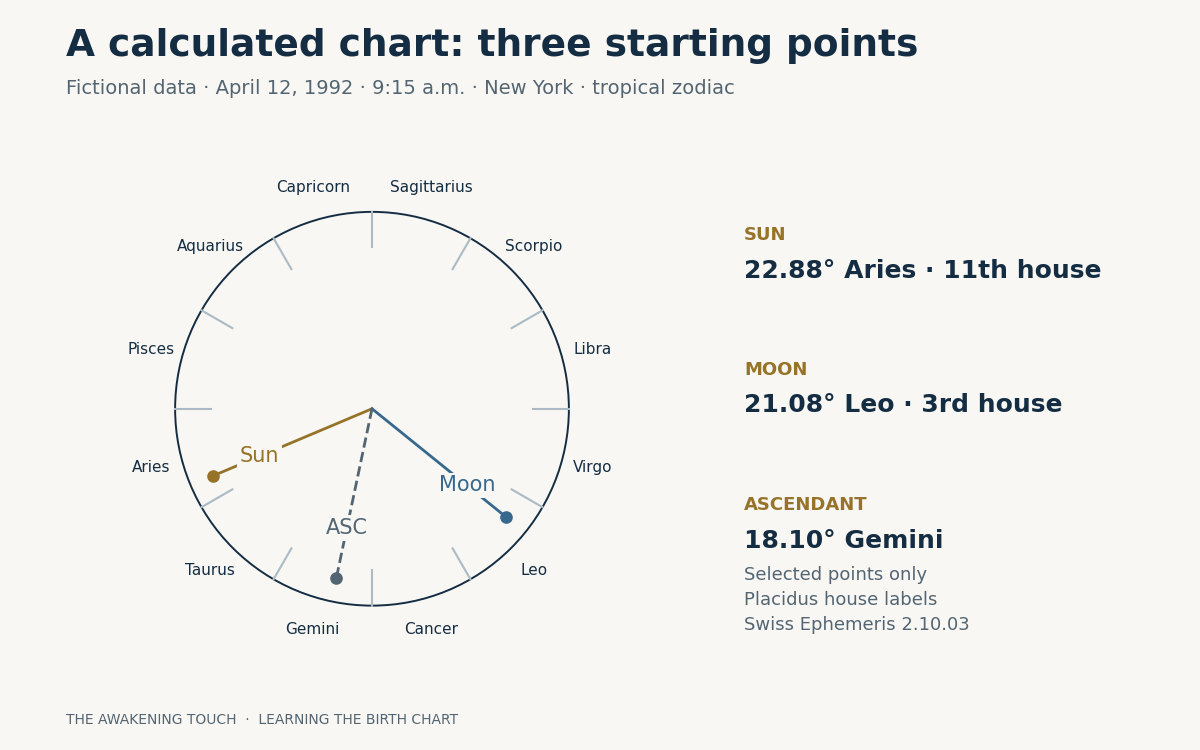
- Calculation: Swiss Ephemeris 2.10.03. Positions below are rounded to two decimal degrees.
The date, time, and city were selected for this tutorial. No private birth information is used. House assignments here follow the planet’s zodiac longitude between the calculated cusps.
Step 1: record the placements before interpreting
| Point | Tropical position | Placidus house |
|---|---|---|
| Sun | 22.88° Aries | 11th |
| Moon | 21.08° Leo | 3rd |
| Mercury | 29.20° Pisces | 11th |
| Venus | 6.47° Aries | 11th |
| Mars | 11.99° Pisces | 10th |
| Ascendant | 18.10° Gemini | First-house cusp |
| Midheaven | 23.41° Aquarius | Tenth-house cusp |
Decimal degrees are not degrees and arcminutes: 22.88° means 22 degrees plus 0.88 of a degree, approximately 22°53′. A different display format should not be mistaken for a different placement.
Step 2: begin with the Big Three
Aries Sun: begin with initiative, directness, and the wish to try something. A useful question is, “Where does taking the first step feel meaningful?” Do not turn that into “This person is always fearless.”
Leo Moon: consider warmth, play, creative expression, and appreciation as possible emotional themes. Ask, “What kinds of participation feel enjoyable and supportive?” This is not a diagnosis of emotional needs.
Gemini rising: explore curiosity and exchange as a possible approach to new situations. Ask, “Does gathering information help this person begin?” The Ascendant is a horizon point, not another planet.
For the distinctions behind these questions, see Sun, Moon, and rising signs explained.
Step 3: add the life-area context
The Sun’s 11th-house position brings groups, friendships, and shared aims into the reading. Rather than predicting popularity, ask whether initiating a shared project could be a useful form of self-expression.
The Moon’s 3rd-house position adds everyday conversation and learning. That might suggest noticing the difference between receiving generic praise and enjoying a lively exchange about an actual idea.
We now have a connection: starting something with others and feeling engaged through warm, creative conversation. It is a working interpretation to test against experience, not a conclusion forced by the chart.
Step 4: connect the Sun and Moon by aspect
The Sun’s longitude is about 22.88°. The Moon’s is about 141.08°. Their smaller separation is approximately 118.20°, which is 1.80° from an exact 120° trine.
Astrologers commonly associate a trine with cooperation or ease. Here, one could ask whether taking initiative and enjoying the exchange support each other. That does not mean there are no tensions elsewhere in the chart, or that every creative plan will succeed.
Step 5: follow the Ascendant’s ruler
Gemini’s ruler is Mercury. In this chart Mercury is in Pisces in the 11th house. A symbolic reading could explore an imaginative or associative style of communication within a group, alongside the Sun’s more direct initiative.
Those themes need not be forced into one stereotype. A practical question is, “How could an imaginative idea be made clear enough for other people to work with?” Writing down one concrete next step might be a useful experiment.
A short interpretation that joins the pieces
“This chart can be used to explore a curious approach to people and a wish to contribute ideas to shared projects. Taking initiative may feel most engaging when there is room for warmth, creativity, and everyday exchange. One useful experiment is to share a small idea with a trusted group, listen carefully, and turn the conversation into a clear next step.”
This original educational synthesis connects selected placements in a short paragraph. The personalized Complete Birth Chart goes further through dedicated sections for planetary signs, house placements, house rulers, and aspects. The optional paid report includes PDF delivery and access through your account, as shown in the current offer.
What this example leaves out
We have not interpreted every planet, house ruler, aspect, or technique. Adding those layers may change the emphasis. A different house system also changes some assignments: Mercury falls in the 10th under Whole Sign for this same data, while its Pisces longitude remains unchanged.
If this were an actual unknown-time birth, the Ascendant and house-based steps would need to be set aside. Precise calculation depends on reliable input; interpretive language should never hide that limit.
Apply the method to your own chart
Generate your free birth chart and sample reading. Identify three placements, one house context, and one close aspect, then write a paragraph that allows you to agree or disagree. For additional interpretation, review the optional complete report shown with your chart.
Calculation reference: Swiss Ephemeris documentation. Astrology is an interpretive tradition, distinct from the scientific study of celestial objects; see NASA’s explanation of constellations and the astronomy/astrology distinction.
New to chart reading? Start with our beginner’s guide to reading a birth chart, then return to this worked example.

Join the conversation
What did this article awaken in you?
Share your experience or ask a question. Your perspective is part of this conversation.
1 conversa