
Updated on November 1, 2026.
In this article
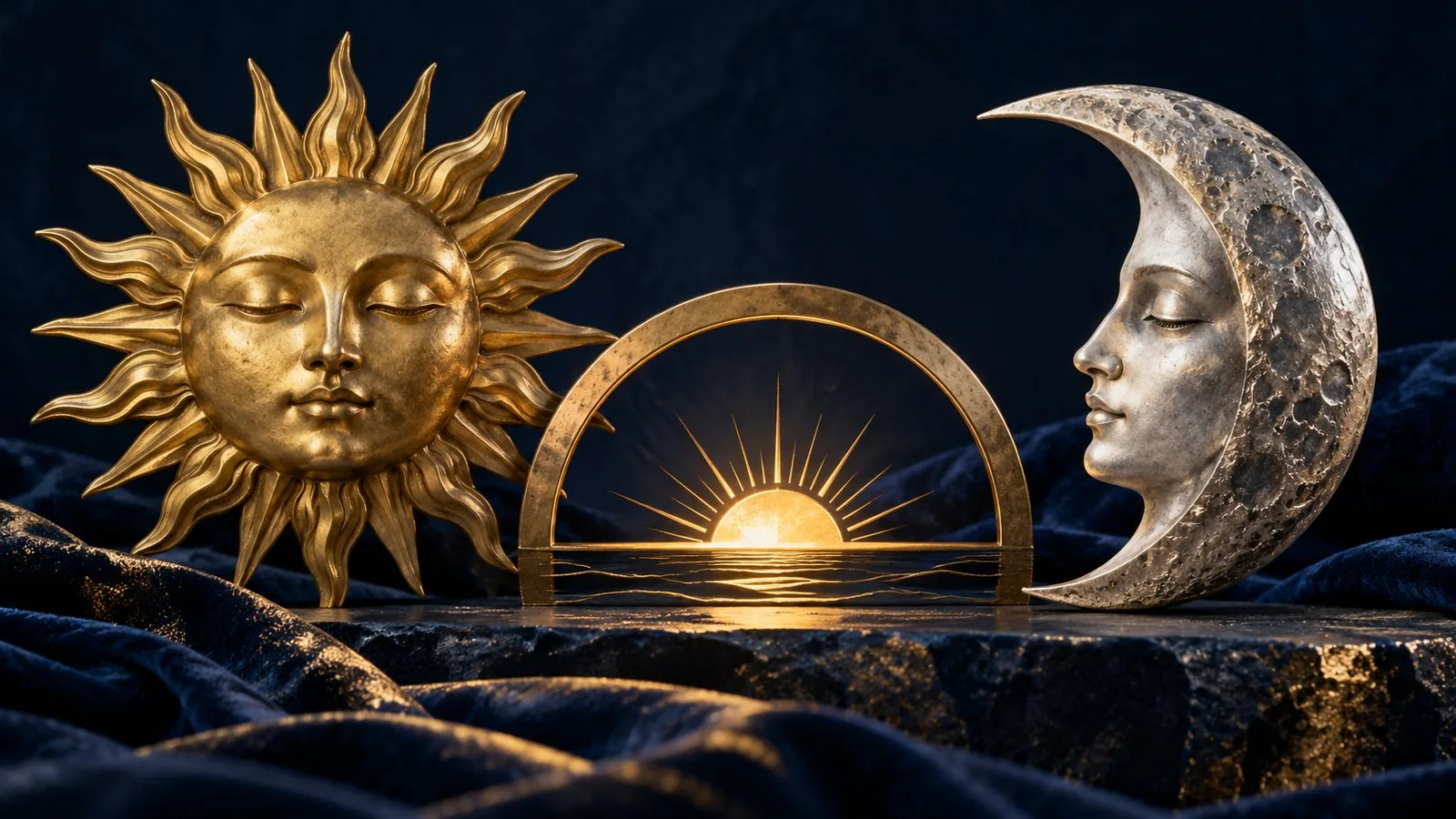
Your Sun, Moon, and rising signs are often called your “Big Three.” Your Sun sign is the Sun’s zodiac position at birth; your Moon sign is the Moon’s position; your rising sign is the sign on the eastern horizon at that time and place. They are three starting points for reading a birth chart, rather than three competing answers to “What sign am I?”
To find the complete set, calculate your Sun, Moon, and rising signs using your birth date, local time, and birthplace. An accurate rising sign requires a reliable birth time.
The Big Three at a glance
| Placement | What is calculated? | A useful reflection prompt |
|---|---|---|
| Sun | The Sun’s zodiac longitude | What do I want to express or develop? |
| Moon | The Moon’s zodiac longitude | What helps me feel emotionally at home? |
| Rising / Ascendant | The zodiac point on the eastern horizon | How do I approach a new situation? |
The Ascendant is an angle, not a planet. “Three planetary placements” is therefore not quite the right description. These interpretive prompts belong to astrology; they are not validated psychological measurements.
Your Sun sign: a theme of self-expression
The Sun is the placement most people mean when they say, “I’m a Taurus” or “I’m a Sagittarius.” In a natal reading, astrologers often use it to explore purpose, conscious direction, and the ways a person wants to participate in life.
An Aries Sun, for example, can be a prompt to consider initiative: Where do you enjoy starting something? When does acting quickly help, and when would a pause be useful? That question is more informative than assuming an Aries Sun makes someone impatient in every setting.
If your birthday is near a sign boundary, a date range in a magazine may be too approximate. The Sun changes signs at a particular instant that varies from year to year. Check the calculation and the reliability of your birth details.
Your Moon sign: emotional habits and comfort
The Moon is commonly read as a symbol for familiar emotional responses, private needs, and the things that feel reassuring. It does not measure mental health, and a difficult description should never be treated as a diagnosis.
A Leo Moon could invite reflection on warmth, play, and feeling appreciated. Does sharing something creative help you reconnect with yourself? Do you find it easy to ask for recognition? Your answer may be yes, no, or dependent on the situation.
The Moon moves much faster through the zodiac than the Sun. On some dates it changes signs during the day. If the birth time is unknown, a single noon calculation cannot always establish the correct Moon sign.
Your rising sign: the chart’s horizon
The rising sign anchors the chart to a particular time and place. In Placidus, the house system used by our calculator, the Ascendant marks the first-house cusp. Astrologers often connect it with the way a person meets unfamiliar experiences and begins an interaction.
Gemini rising can be explored through questions about curiosity and exchange: Do you enter a room by asking questions? Do you like to gather information before deciding where you stand? This is a possible symbolic reading, not proof of a particular social style.
For the calculation and birth-time limits, see what a rising sign is and how to find it.
How to combine Sun, Moon, and rising signs
Do not read three descriptions and choose whichever seems most flattering. Give each placement a different role, then look for an interaction. Here is a fictional teaching combination: Aries Sun, Leo Moon, and Gemini rising.
- Sun / direction: “I want to try something new and take initiative.”
- Moon / comfort: “I may feel supported when there is warmth, enjoyment, and room to create.”
- Rising / approach: “I may open a situation through conversation, questions, or several possibilities.”
- Synthesis: “Could a small creative project, discussed with others, be a useful way to test a new idea?”
The last sentence combines the symbols without predicting an event or declaring a permanent personality trait. It gives the reader something specific to consider and the freedom to reject it.
What if the three signs seem to contradict each other?
That is not a calculation error by itself. A person may want visibility in one context and privacy in another. A chart reading becomes more useful when it allows different needs instead of forcing every placement into the same label.
Check the data first, especially a.m./p.m. and birthplace. Then consider houses and aspects. The Big Three leave out Mercury, Venus, Mars, other planets, and the relationships between them; they are an introduction to the chart, not a complete interpretation.
Can you find the Big Three without a birth time?
You can often establish the Sun sign from the date, except near a sign change. The Moon may need a whole-day check. The rising sign cannot be calculated reliably without enough information about the birth time and location.
If your time is unknown, choose that option rather than entering an invented time. Our calculator uses noon as a reference and flags the limitations; it does not recover your actual time.
Try it with your own chart
Get your free birth chart and sample reading. Write one question for each of your Big Three, then compare the result with your lived experience. If you want to explore more placements, review the optional complete report and its current offer after generating your chart.
Next, follow our beginner’s guide to reading a birth chart or work through a complete interpretation example.

Join the conversation
What did this article awaken in you?
Share your experience or ask a question. Your perspective is part of this conversation.
3 conversas