

In this article
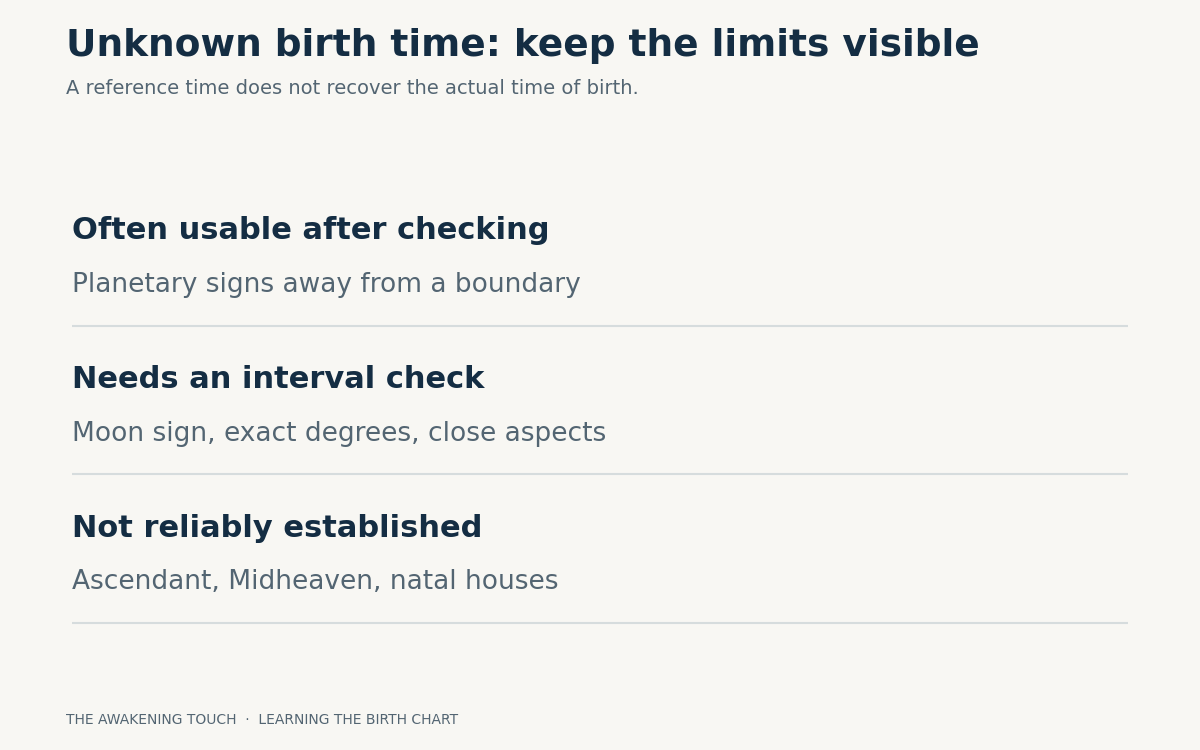
You can calculate a birth chart without a birth time, but you cannot reliably establish the Ascendant or house placements from the date alone. Some planetary signs may still be usable; others, especially the Moon near a sign change, need a check across the possible birth interval.
The helpful question is not “Can a tool draw a chart?” It is “Which parts of that chart are supported by the information I actually have?” A detailed wheel does not remove uncertainty in the input.
What can you read without a birth time?
| Chart feature | How to treat it |
|---|---|
| Sun sign | Often clear from the date, but check the full interval near a sign change. |
| Moon sign and degree | Time-sensitive. A noon result may miss a change of sign during the day. |
| Other planetary signs | Often stable over a day; still check any planet near a sign boundary. |
| Ascendant and Midheaven | Do not treat them as known without a sufficiently reliable birth time. |
| Houses | Do not interpret noon house placements as actual natal houses. |
| Aspects | Some remain stable; Moon aspects and aspects to angles are particularly sensitive. |
Astrology uses these placements symbolically. Knowing a planetary position accurately does not turn its interpretation into a scientifically validated prediction.
Why do calculators use noon?
Noon is a reference time, not an estimate of when you were born. A calculation needs an instant. Choosing 12:00 gives the program an explicit one while keeping the missing information visible.
On The Awakening Touch, select the unknown birth time option in the birth chart calculator. The reading uses noon as a reference and omits time-sensitive interpretations involving the Moon, Ascendant, Midheaven, Vertex, and Part of Fortune, as well as planetary house interpretations. These elements depend on the missing time. Do not enter 12:00 as a known birth time just to fill a required field.
A noon chart can be useful for organizing approximate planetary information. It cannot tell you your rising sign, and it does not prove that a planet’s exact degree or house was the same at your actual birth.
Can you know your Moon sign without the time?
Sometimes. If the Moon remains in the same sign throughout the entire possible birth interval, that sign is more secure even though the degree is uncertain. If it crosses a boundary during the interval, there are at least two possible signs.
A single calculation at midday does not perform that whole-day check. To resolve the question, compare the start and end of the local birth date with a reliable ephemeris, allowing for the correct historical time zone. If the time is only partly known, use that narrower interval.
Do not choose between two possible Moon signs solely because one description “sounds more like you.” Broad descriptions can fit many people, and personal identification is not a substitute for a recorded time.
What if you know only “morning” or “around dinner”?
Keep the information in its original form. “Between 7 a.m. and 9 a.m.” is an interval, not an exact 8 a.m. birth time. Calculate the plausible endpoints and check which chart features change. Even if a rising sign stays the same, its degree and the house cusps can shift.
For example, a family memory of “after breakfast” may help you ask better questions about records. It does not justify a precise time such as 8:17 a.m. Never make the output appear more precise than the evidence.
Where can you look for a recorded birth time?
- A long-form birth record, where available. Not every certificate includes a time.
- Hospital or birth-center records, subject to the institution’s retention and access rules.
- A contemporary baby book, family diary, or written announcement.
- Family recollections, clearly labeled as estimates rather than official records.
Availability and access rules vary. There is no need to share a full identity document publicly or send it to a stranger to obtain a chart. Use the relevant information privately and keep the original record secure.
Can birth-time rectification recover the exact time?
Rectification is an astrological practice that proposes a time by comparing possible charts with reported life events. It is an interpretation-dependent estimate, not independent documentary proof. Results may differ between practitioners and methods.
If you explore it, keep the proposed time labeled as rectified or estimated. Do not replace a reliable record just because a different chart feels more appealing.
A useful way to work with uncertainty
- Write down what is known: date, place, and any genuine time interval.
- Use the unknown-time option for a date-only calculation.
- Set aside rising sign, houses, and angle-based conclusions.
- Mark any planet near a sign boundary as needing an interval check.
- Keep your notes provisional and update them if a reliable record becomes available.
You can still learn the language of planetary signs and ask reflective questions. An honest partial reading is more useful than a complete-looking chart built on an invented time.
Calculate a birth chart with the unknown-time option. Review the free sample before considering the optional complete report; paying for a reading cannot supply missing birth-time evidence.
For the horizon’s role in a chart, read what a rising sign is. Our birth chart reading guide explains how to keep reliable placements separate from uncertain ones.
Join the conversation
What did this article awaken in you?
Share your experience or ask a question. Your perspective is part of this conversation.