
In this article
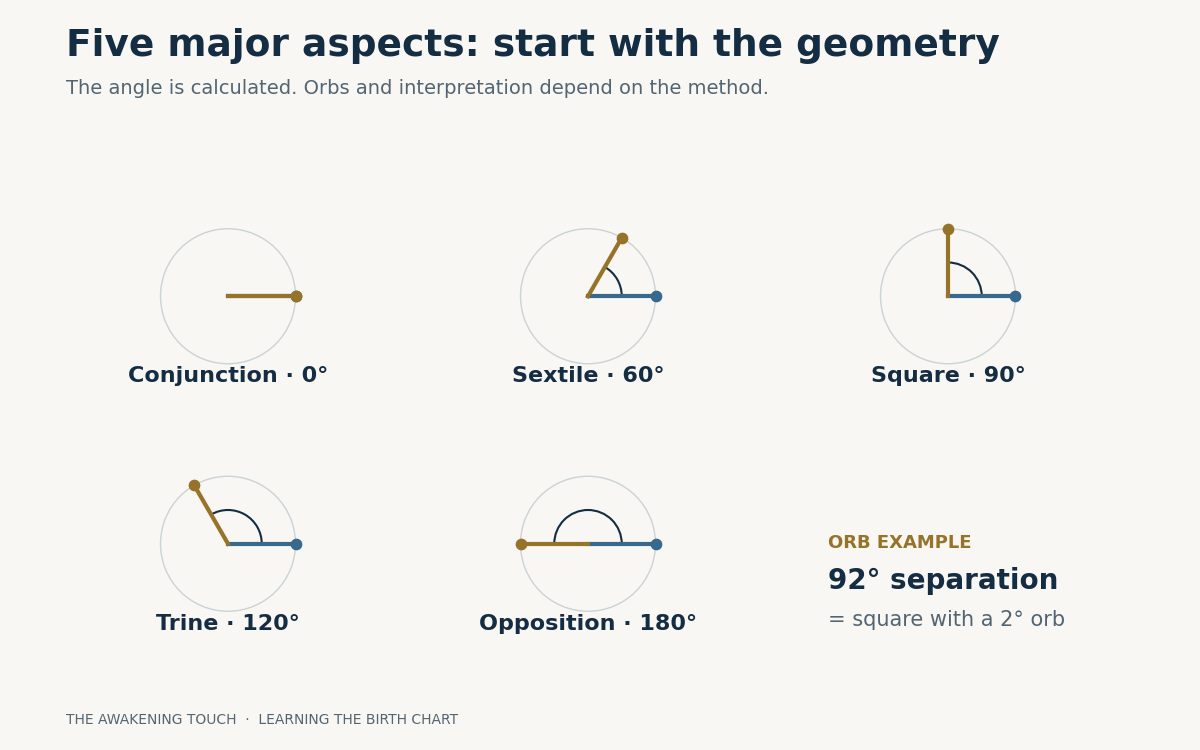
Birth chart aspects are angular relationships between planets or other chart points. The five major aspects are conjunction (0°), sextile (60°), square (90°), trine (120°), and opposition (180°). An orb tells you how far a relationship is from its exact angle.
Aspects help connect placements instead of reading every sign description in isolation. Open the aspect table in your free birth chart and start with one close major aspect. The geometry can be calculated; the meaning assigned to it belongs to an astrological tradition.
The five major aspects
| Aspect | Exact angle | Interpretive starting point |
|---|---|---|
| Conjunction | 0° | Concentration or blending of themes |
| Sextile | 60° | A possible connection to develop through participation |
| Square | 90° | Friction, adjustment, or competing demands |
| Trine | 120° | Ease or cooperation that may feel familiar |
| Opposition | 180° | A polarity that asks for perspective or balance |
The Awakening Touch chart also supports the quincunx at 150°, often read as a need for adjustment between themes that do not fit together easily. The diagram above focuses on the five major aspects; it is not a list of every aspect supported by the chart.
The planets, signs, houses, and context affect the reading. A conjunction can combine difficult themes as well as harmonious ones, while a square can become a useful focus for deliberate effort.
What is an orb?
Most chart relationships are not exact. If two planets are 92° apart, they are 2° from an exact square. That difference is the orb.
A tool might include that square under a 5° allowance and omit another relationship under a narrower allowance. There is no single orb setting used by every astrologer. Some use different limits for different aspects, planets, or techniques.
When comparing charts, record the settings. A missing line may reflect a display choice rather than a different planetary position. Tight aspects are often a manageable place for beginners to start because they depend less on a generous cutoff.
How to calculate an aspect
- Convert each position to zodiac longitude. Aries starts at 0°, Taurus at 30°, Gemini at 60°, and so on.
- Find the absolute difference. Subtract the smaller longitude from the larger.
- Use the smaller circular separation. If the difference exceeds 180°, subtract it from 360°.
- Compare with an aspect angle. The difference from that exact angle is the orb.
For a schematic example, place the Sun at 10° Aries and the Moon at 12° Cancer. Their longitudes are 10° and 102°. The separation is 92°, so the relationship is a square with a 2° orb. These are invented teaching positions, not the full calculated example below.
Remember the circular boundary: 29° Pisces is 359°, while 1° Aries is 1°. Those positions are only 2° apart, not 358°. That is why the smaller circular separation matters.
A worked Sun–Moon trine
In our fictional calculated chart for April 12, 1992, 9:15 a.m. in New York City, the Sun is at approximately 22.88° Aries and the Moon at 21.08° Leo. In zodiac longitude, those are 22.88° and 141.08°.
141.08° − 22.88° = 118.20°. The exact trine is 120°, so the orb is approximately 1.80°. In degrees and arcminutes, that is about 1°48′, the kind of notation used in the report. The two formats describe the same angular difference.
One symbolic interpretation would explore how initiative and warmth might cooperate. A practical question is: “When does acting on a creative idea also help me feel emotionally engaged?” A different reader may frame the symbolism differently.
Why signs alone are not enough
Signs can suggest a broad relationship, but degree-based aspects need degrees. Planets in neighboring signs can be close to a conjunction near a boundary. Planets in signs normally associated with a trine may sit too far from 120° for the chosen orb.
Read the calculated aspect table instead of assuming a line from sign names. Also distinguish a relationship between two planets from an aspect to the Ascendant or Midheaven: angles need a reliable birth time.
What if the birth time is unknown?
Some aspects between slower-moving bodies may remain similar across the day. The Moon moves quickly, and aspects involving the Moon can change substantially. Aspects to the Ascendant and Midheaven cannot be treated as established from a default noon time.
If an aspect is close to the chosen orb limit, check the possible time interval before treating it as secure. More decimal places in the output do not fix uncertain birth data.
Read connections, not verdicts
Choose one aspect, name the two themes, and ask how they might interact. Look for a concrete situation to reflect on rather than predicting events. Astrology is not a scientifically validated way to determine health, relationship outcomes, or financial decisions.
Explore the aspects in your free birth chart. Use the sample to get oriented. The optional complete report is a separate purchase if you want additional interpretation.
Example calculation: tropical, geocentric, Swiss Ephemeris 2.10.03. Technical reference: Swiss Ephemeris programming documentation. Exact angles are conventional aspect definitions; orb choices and interpretations vary.
See these relationships in context in our step-by-step interpretation example, or begin with the birth chart reading guide.
Join the conversation
What did this article awaken in you?
Share your experience or ask a question. Your perspective is part of this conversation.