

Updated on October 31, 2026.
In this article
Psychics trained as spies, millions of dollars invested in “remote viewing,” and secret documents: the Stargate Project was the CIA program that defied science to explore the unseen. For 23 years, the agency tested whether the human mind could access enemy sites without ever leaving the laboratory—and declassified files reveal descriptions of nuclear bases, embassies, and even distant planets. But why, despite its purported successes, did the government bury the initiative? The answer lies in the reports that expose the line between the extraordinary and the harsh reality of intelligence.
1. Introduction — Historical Context and Objective
At the height of the Cold War, CIA reports on Soviet experiments with the LIDA Project—which explored the use of extremely low frequency (ELF) waves to influence the human mind—prompted the US to launch covert research into parapsychology. In response, in 1972, the CIA allocated $50,000 (equivalent to $320,000 in today’s values) to Project SCANATE (Scanning by Coordinate), conducted in partnership with the Stanford Research Institute (SRI) in California. This pioneering initiative gave rise to what would later be christened the Stargate Project, whose stated objective was “investigate the potential of extrasensory perception and remote viewing for application in military intelligence and national defense operations”.
\n\n\n\nInternal CIA documents from 1972 reveal that the program emerged as a systematic strategy to counter the alleged psychic capabilities of geopolitical adversaries. The records underscored the need for a scientific and methodological approach, combining theoretical and practical research, to “comprehensively assess the use of these abilities in operational contexts.” The primary focus fell on remote viewing (remote viewing), defined as the ability to describe distant locations or events without physical or sensory contact.
\n\n\n\nOperational Evolution and Investment
\n\n\n\nBetween 1972 and 1995, the project operated under several code names, reflecting distinct phases: GONDOLA WISH (testing with military personnel), SUN STREAK (following congressional audits in 1977), and GRILL FLAME (under Army management beginning in 1978). The budget expanded significantly: from $500,000 between 1972 and 1979 (an annual average of $62,500) to $1.2 million per year in the 1980s (managed by the DIA) and, finally, $2 million per year between 1991 and 1995, funded by the National Defense Authorization Act.
A 1978 memo indicates that the bulk of the initial resources was directed toward training individuals such as Ingo Swann and Pat Price, considered the most accurate remote viewers. Double-blind tests conducted by SRI reported hit rates above chance on specific targets (SRI Technical Report SRI-78-1), although critics question the replicability of these findings.
This article analyzes the trajectory, techniques, and conclusions of Project Stargate based exclusively on declassified documents from agencies such as the CIA, NSA, and DIA.
2. Origins — Beginnings in the 1970s and Key Figures
The origins of the Stargate Project are linked to intelligence initiatives of the US that explored psychic phenomena as a strategic tool. Its history dates back to the early 1970s, when the CIA, in partnership with the Stanford Research Institute (SRI) in California, launched Project SCANATE. The goal was to investigate the feasibility of abilities like “remote viewing” (remote viewing), a technique that supposedly allowed individuals to access information distant in space and time.
Academic Phase: SCANATE and the Pioneers
Under the leadership of physicists Harold Puthoff and Russell Targ, SRI developed scientific protocols to test remote viewing (designated RV-1). Among the participants were individuals considered gifted with psychic abilities, such as Uri Geller, known for his psychokinetic capacities, and other figures such as Ingo Swann and Pat Price. Experiments conducted at the time claimed surprising results: 1986 CIA documents highlight that tests with these “psychic subjects” yielded “detailed and accurate information” regarding strategic targets, such as: Facilities NSA secrets; Soviet nuclear research centers in Semipalatinsk; Libyan military bases; Chinese embassies in Africa.
These initial results, though debated, convinced agencies that the subject warranted ongoing investigation.
Transition to the Military Sphere (1977-1978)
In 1977, the U.S. Army took on a central role with Project Gondola Wish, led by the INSCOM intelligence unit. The objective was to explore practical applications of remote viewing in military operations. However, in 1978, an institutional review concluded that fragmented efforts (such as Gondola Wish) should be unified. Thus emerged Project Grill Flame, a collaboration between the Army and the Defense Intelligence Agency (DIA), based at Fort Meade, Maryland.
Grill Flame operated until 1983, consolidating methods and training. Official reports cite the creation of a “standard remote viewing protocol” by Puthoff and Targ in 1978, which was used to instruct operatives. Figures such as Swann and Price became benchmarks within the program, described in documents as “key elements” due to the accuracy of their descriptions.
Consolidation
In the mid-1980s, Project Stargate emerged as the direct successor to Grill Flame, under the coordination of the DIA. Its framework integrated decades of research, combining academic rigor (inherited from SRI) with operational intelligence requirements. Core features of Stargate included:
- Standardized methodology: Based on manuals by Puthoff and Targ;
- Focus on intelligence: Geopolitical targets, such as Soviet activities during the Cold War;
- Selectivity: Recruitment of individuals with purported psychic aptitude, subjected to intensive training.
3. Official Documents — Excerpts from Declassified Files
The declassified files from the CIA, DIA, and NSA reveal remarkable details about Stargate. Among them are technical reports, session transcripts, and internal presentations. Below, we present some representative excerpts from these documents, accompanied by technical interpretation:
- The training protocol itself appears in internal CIA documents. For example, the summary of a training session in 1978 (during the early phase at SRI) describes the procedure: there is a “monitor” who guides the “remote viewer” after providing a set of coded coordinates. The official report notes that “the protocol used for this session … is detailed in the document Standard Remote-Viewing Protocol (Puthoff & Targ, 1978)” (cia.gov). In the attached transcript, one can see that the monitor asked the mental viewer to form an image and describe the target, aiming to quiet their mind. The report concludes by confirming: “this session was considered very successful… the target site had characteristics that matched the observer’s descriptions” (cia.gov). This official excerpt demonstrates that, at least in training, there were reports of correlation between remote viewing and the actual target, which motivated the participants.
- On the other hand, other documents point to failures. One example is the session summary No. 898 (1982) under the Grill Flame program. The CIA report notes: “post-session analysis indicates that the viewer had only some correlation” with the target; moreover, “the viewer’s attitude was not positive” (cia.gov). In other words, not all exercises produced clear hits. Thus, the official files themselves acknowledge that results varied in accuracy and that participants’ behavioral factors influenced success.
- In addition to reports, there are slides and internal presentations. A presentation titled “Sun Streak Activities Report 1986” (a Stargate project operated by the DIA) reports that “experiments using remote viewing… conducted by two physicists [from SRI] were successful” (cia.gov). A classified slide details: “Using several gifted psychic subjects (such as Pat Price and Ingo Swann), SRI scientists conducted several CIA-sponsored remote viewing tests. Psychic impressions included detailed and accurate information about a secret NSA site, the Soviet facility at Semipalatinsk, guerrilla bases in Libya, and a Chinese embassy in Africa” (cia.govcia.gov). Such documents reinforce that the agencies intended to combine technique and rigorous control; for example, the slides explained that each CRV session was a “team process” between a monitor and a viewer (cia.gov), and that the monitor presented encrypted coordinates to the viewer, whose passive nervous system reacted to the “energy” of the mental pattern (gestalt) corresponding to the target (cia.gov). The viewer would then draw an “ideogram,” followed by a detailed description of the targeted site. This procedure is documented in internal diagrams approved for release by the CIA (cia.gov).
- Another NSA document illustrates the type of experiment conducted in the early 1970s: titled “Psychic Probe of the Planet Jupiter” (1973), it describes an attempt coordinated by Ingo Swann and parapsychologist Harold Sherman to remotely view characteristics of the planet Jupiter (cia.gov). Although they concluded that neither claimed statistical validity for their results (“Neither Mr Sherman nor Mr Swann claim validity for their results” cia.gov), this experiment indicates the early interest in testing limits, even beyond terrestrial targets.
In summary, the official documents—project reports, internal memos, session transcripts, and FOIA presentations—provide the factual basis for the Stargate program. They contain declassified excerpts that, when analyzed technically, confirm the methodology adopted (remote viewing protocols), the claimed results (sometimes positive, sometimes inconclusive), and the agencies’ conclusions. Each excerpt cited above comes from original records released by the government (for example, CIA-RDP96), which can be consulted in the FOIA repository, lending legitimacy to the technical narrative presented here.
4. Techniques Used — Remote Viewing and the Gateway Process
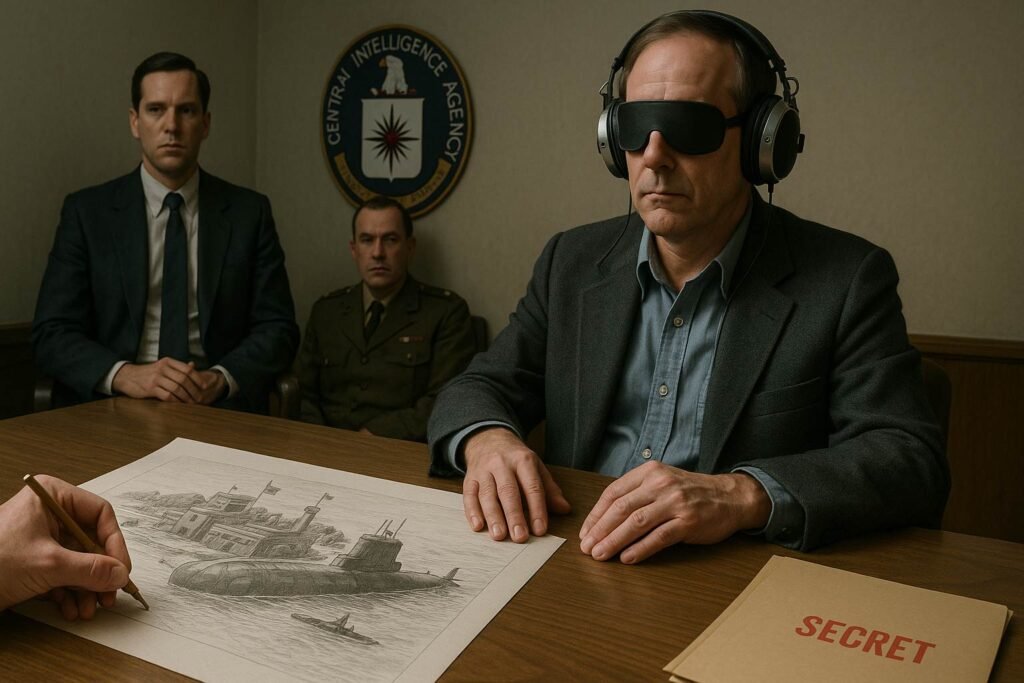
Project Stargate documents detail “remote viewing” techniques and training methods used in the experiments. The core methodology was Coordinate Remote Viewing (CRV), developed at SRI. This protocol involved a monitor (guide) and a viewer (a subject with presumed ability). The monitor provided a coded number or coordinate corresponding to a location (the “target”), while the viewer entered an altered state of consciousness to intuitively perceive the targeted site (cia.govcia.gov). Internally, project slides explain that, upon receiving the coordinates, the observer’s autonomic nervous system responds to the “energy” of the target’s mental pattern, and this reaction is expressed as a quick sketch on paper—the so-called ideogram (cia.gov). From this initial sketch, the viewer makes detailed descriptions in natural language, jotting down structures, emotions, sounds, or other impressions they “felt” coming from the distant location.
Training for the team of viewers was rigorous. One document notes that each session was “a dynamic team process” (cia.gov): the monitor maintained focus and context, while the observer generated mental images. The goal was to maintain a receptive mental state without bias. The standard protocol emphasizes: “The requirement to describe the target must be established. The stimulus is provided by a neutral word… Then the viewer will report what formed in their mind” (cia.gov). (This description corresponds to the standardized procedure mentioned in CIA reports.) In official session reports, analyses were conducted at the end to compare what the observer described with photographs of the actual target in order to measure correlation. In obtained examples, certain local environmental targets (such as landscapes near SRI) were accurately described through visualization, providing “positive feedback” to the trainees (cia.gov).
In addition to traditional CRV, the Stargate Project evaluated complementary techniques to expand mental capabilities. A notable example was the Gateway Process, developed by the Monroe Institute. A 1983 CIA report (Analysis and Assessment of Gateway Process) describes this approach as using brain hemisphere synchronization (which the Monroe program called the “Gateway Experience”) to achieve profound altered states of consciousness (cia.gov). In technical terms, Gateway used binaural beat audios (Hemi-Sync) and mental exercises to synchronize the brain’s hemispheres, facilitating deep meditations or out-of-body experiences. The official document explains that Gateway combined concepts of hypnosis, transcendental meditation, and biofeedback to achieve these states (cia.gov). Although not part of the day-to-day remote viewing methodology, the CIA analyzed Gateway as a possible way to “accelerate” or enhance psychic training. In the report, the author concludes that Gateway offers a useful conceptual framework, but acknowledges that its validity would only stand after more rigorous rational testing (cia.gov). In short, officials viewed Gateway as a bridge between meditation and remote viewing, pointing toward the frontier between consciousness research and military experimentation.
Thus, the techniques used by Project Stargate were multidisciplinary. The core element was coordinate remote viewing, featuring formal protocols drawn from Puthoff/Targ documents (1978) and controlled training. There were also secondary investigations (such as the Gateway Process) to explore advanced mental states. Official documents reveal a concern with standardizing and documenting these methods under intelligence criteria—for instance, the training emphasized observer neutrality and rigorous documentation for each session (cia.gov, cia.gov). At the same time, studies such as the Jupiter experiment (cia.gov) and various test sessions demonstrated an effort to bring scientific rigor to the unusual, seeking objective evidence even on controversial topics.
5. Notable cases — documented psychic sessions
The declassified files record multiple examples of sessions and experiments, some with documented results. Among the most frequently cited cases are:
- Training Session #1 (1978, SRI): This was the first official laboratory RV session, used to guide the protocol. The summary report for this session states that it was “considered very successful by all” cia.gov). According to the document, “the target site contained features that corresponded to the viewer’s descriptions” (cia.gov). The available excerpt shows dialogue in which the viewer is encouraged to form an image and begins describing an environment; during the analysis, it is noted that key items of the actual setting matched what he reported. This early case illustrates how researchers viewed the initial demonstrations of mind-target correlation as promising.
- Session 898 (1982, Grill Flame): In contrast to the previous example, the official report for this session reveals only partial success. It states that, following analysis, “the viewer had some correlation” with the target, but his attitude “was not positive” (cia.gov). In other words, the viewer logged some correct clues, but not convincingly. This document shows that not all sessions yielded clear results. Internal technicians highlight that factors such as the viewer’s emotional state may have hindered performance.
- “Jupiter” Experiment (1973, NSA/SRI): In a collaborative experiment, parapsychologist Harold Sherman and Ingo Swann conducted, simultaneously at different locations, a “psychic probe” of the planet Jupiter (cia.gov). Despite expectations initial findings (the Pioneer 10 probe was transmitting data about Jupiter), both participants concluded that they could not scientifically validate their impressions. The NSA report notes: “neither Sherman nor Swann claims validity for their results, since such a claim would be scientifically out of order” (cia.gov). This case did not involve a traditional terrestrial target, but it was recorded as an emblematic effort to go “beyond” the usual.
- Other reports mention activities that, while not fully disclosed, are well-known. For example, CIA-NSA work indicates the use of viewers in real-world operations, such as the remote tracking of military targets. Although few official details have been released, FOIA documents reveal that some viewers were recruited for “intelligence collection tasks” under military supervision. However, the available texts focus more on general results than on specific operational cases.
Broadly speaking, the documented cases present a mixed picture: some training sessions produced coherent descriptions of the target, while others failed to achieve reliable levels of information. The documents cited above are officially disclosed examples that illustrate the variability of the results. They serve to understand the practical “fruits” of the program, always with critical caution: in a 1995 manual, the final CIA report emphasizes that the data obtained was often “vague and ambiguous,” incapable of generating actionable intelligence (cia.gov). Despite this, over the course of two decades there were reports—official or anecdotal—of viewers detailing secrets of installations that, in their view, could never have been known through conventional methods. These notorious cases, drawn from the archives, helped fuel the internal debate over the credibility of psychic work.
6. Evaluation and Closure — Official Conclusions and Debates
The final stage of Project Stargate culminated in formal evaluations and management decisions. CIA documents from 1995 reveal that, following intensive analysis, senior leadership determined to terminate the program. According to an internal memorandum, the primary recommendation was specifically to “terminate remote viewing operations within the Intelligence Community” and cease “R&D related to remote viewing”cia.govcia.gov. This decision was supported by a contracted expert panel (American Institutes for Research) that concluded the remote information obtained was of insufficient quality. The report notes that “it remains unclear whether the existence of a paranormal, remote viewing phenomenon has been demonstrated” and that “the laboratory studies do not provide evidence regarding the origins or nature of the phenomenon” (cia.gov). Such conclusions reflect a critical institutional stance: according to the CIA, the results were inconsistent and failed to prove that reliable data could be obtained in a controlled manner.
On the other hand, there were dissenting voices behind the scenes. Some proponents and participants in the program reported positive experiences that allegedly validated the method, suggesting it was simply a matter of better calibrating the techniques or the individuals. However, the released official literature does not cite external support or favorable arguments. The emphasis is on statistical analyses and the opinions of the independent experts hired. The official view (of the CIA/DIA) became public via a documentary and the release of its conclusions in 1995: basically, the program had produced no “actionable intelligence” (en.wikipedia.org). Critics of the project frequently used this official conclusion to discredit the overall validity of remote viewing, while some enthusiasts believe that parts of the program were simply interpreted with excessive skepticism.
Furthermore, recent documents highlight that, to this day, the government continues to view the topic as low-risk. An internal report by the CIA’s Directorate of Intelligence, after evaluating contemporary Russian parapsychology programs, concluded that such developments pose a “relatively low threat” and are a “low priority” compared to other global threats (cia.gov). Broadly speaking, although the project was officially discontinued, there was no formal statement opposing the mere scientific investigation of human consciousness; however, its intelligence application was deemed unfeasible following the analyses of the 1990s. Thus, the end of Stargate was the result of both technical evaluation and a shift in priorities following the end of the Cold War.
7. Current impact — influence on consciousness science, psychology, and security
After its official termination, the legacy of Project Stargate continued to generate interest across various fields. In the consciousness science community, the very existence of the program stimulated studies on extrasensory perception and altered states of consciousness—though often on the fringes of mainstream institutions. For example, the Gateway Process’s focus on synchronizing brainwaves inspired subsequent neuroscience research on meditation and the use of binaural beats to induce deep relaxation. Academic papers today explore similar techniques in biofeedback therapies and transpersonal psychology. Additionally, popular narratives about out-of-body experiences and psychic phenomena frequently mention military projects, fueling public debate over the intersection between mind and technology.
In psychology, Stargate reinforced investigations into psychism and intuition, yet that many conventional psychologists remain skeptical. Some independent research centers continue to conduct experiments under protocols inspired by the SRI, attempting to replicate or refine remote viewing tests. Even without the official backing of intelligence agencies, this line of research was legitimized in part by the fact that it had been a subject of government study.
In the realm of national security, the legacy is also notable. Although the CIA’s findings classified psychic work as a low priority (cia.gov), the Stargate experience itself led the intelligence community to reflect on the limits of information gathering. Elements of the project, such as qualitative analysis methodologies for adverse scenarios, have parallels in modern risk analysis and forecasting techniques (for example, structured brainstorming and prospective scenarios). Furthermore, the Gateway Program is sometimes cited in debates about black programs, espionage, and the credibility of official discourse—serving both as an example of investment in extraordinary concepts and as a cautionary tale against premature conclusions. In short, although Stargate did not translate into active espionage operations, its influence on the notion that “anything is possible” was recorded in official reports (which came to consider it a low military risk topic) cia.gov.
Today, declassified files continue to be consulted by researchers interested in the frontier between mind and technology. Stargate is frequently cited in interdisciplinary studies of consciousness, as it provided empirical data (even if inconclusive) on unusual perceptions. Cognitive psychology and mind sciences note that the project encouraged questioning the mechanisms of human thought and their relationship with external information. In the field of intelligence, Stargate became a classic case study on how to scientifically evaluate extraordinary claims, influencing guidelines for methodological rigor in new programs (such as the STIMULUS Initiative). In short, the project left its mark as a large-scale experiment on the limits of human perception, today regarded as an official historical episode—based on public documents—that bridges debates on consciousness, parapsychology, and military utility.
8. Conclusion — mind, perception, and official science
Project Stargate represents an unusual chapter in the history of intelligence and science. On the one hand, it demonstrates that even military agencies can take a formal interest in phenomena deemed paranormal, dedicating resources and academic research to them. Official documents make it clear that for decades there was hope for practical application, sustained by some promising early results (cia.gov, cia.gov). On the other hand, the declassified reports themselves reveal the difficulty in obtaining consistent results. The agencies’ ultimate conclusion was prudent: the method had not proven reliable enough to be maintained in regular operation (cia.gov, cia.gov).
In scientific terms, Stargate prompted reflections on the mind’s ability to access hidden information and on which experimental approaches are valid for investigating it. The use of formal protocols and external reviews (such as the AIR report) illustrated an effort to treat “official science” with rigor—and the failures were often attributed more to methodological shortcomings than to a priori impossibility. Even so, the mere official acknowledgment of such research (and its subsequent public release) recognizes that the interface between mind and reality remains a subject of curiosity and speculation that cannot be completely ignored.
Ultimately, the history of Stargate serves as a case study in skepticism and scientific openness. The key takeaway is that the quest to understand human perception at its frontiers—whether via remote viewing or other techniques—challenges both traditional beliefs and the scientific method. The program’s official legacy, visible today in the declassified documents, is essentially neutral: it shows interest, experimentation, inconclusive data, and, in the end, caution. Thus, Project Stargate symbolizes the effort to reconcile extraordinary mental phenomena with proven research, a an effort that, though concluded, leaves behind questions and lessons about how far human curiosity can go and how conventional science should deal with the unknown.
Sources: This article is based exclusively on declassified U.S. government documents (CIA, DIA, NSA) concerning the Stargate Project, sourced from official repositories. We quote directly from reports, memos, and presentations from these archives to substantiate the information above (cia.gov cia.gov cia.gov cia.gov cia.gov), ensuring fidelity to the original data.



Join the conversation
What did this article awaken in you?
Share your experience or ask a question. Your perspective is part of this conversation.